Drift Is Shutting Down — Best Drift Alternative 2026
Drift was sunset March 2026 after a breach and the Salesloft merger. Canary is the drop-in alternative — AI chatbot, 5-minute setup, no annual contract.
Drift is being shut down. On March 6, 2026, Clari + Salesloft officially announced a "gradual sunset" of Drift and named 1mind as the exclusive designated successor for existing customers. No hard cutoff date has been set, but the product is officially deprecated and unavailable to new customers.
This follows a brutal 18 months: a major OAuth supply-chain breach in August 2025 compromised 700+ organizations including Cloudflare and Palo Alto Networks, the Clari + Salesloft merger completed in December 2025 under new CEO Steve Cox, and a product roadmap reoriented entirely toward enterprise revenue orchestration — leaving SMBs with a $30,000/year price tag and a sunsetting product.
For small businesses, agencies, and SaaS founders who need their websites to answer questions and capture leads intelligently, Canary offers a production-ready path forward: AI chatbots trained on your knowledge base, embedded with a 4KB widget, isolated per tenant, and live in under five minutes — at $127/month for ten tenants.
This guide covers what happened to Drift, how it compares to Canary on the features that matter, and what current Drift users should do next.
Quick Verdict
| Canary | Drift (Clari + Salesloft) | |
|---|---|---|
| Status | Active | Officially sunset (Mar 2026) |
| Best for | SMBs, agencies, multi-tenant use | Enterprise B2B sales teams |
| Starting price | $127/mo (10 tenants) | ~$2,500/mo (1 workspace, est.) |
| Free plan | Yes (development tier) | No |
| Free trial | Yes | No — demo call required |
| Setup time | Under 5 minutes | Weeks (playbook engineering) |
| Widget performance | 4KB, zero CWV impact | ~20 JS assets, −25 mobile PageSpeed |
| Knowledge base AI | OpenAI Vector Stores (native) | Limited (playbook-first) |
| Multi-tenant | Native (per-tenant isolation) | No (single-workspace model) |
| Public pricing | Yes | No |
| Contract | Monthly or annual | Annual only |
| Security incidents | None | 700+ orgs breached (Aug 2025) |
What Happened to Drift?
Drift was founded in 2014 by David Cancel and Elias Torres and launched publicly in 2015 as a "conversational marketing" platform — the idea that B2B buyers shouldn't fill out a static form and wait two days for a callback. A chatbot could qualify them in real time, route them to a rep, and book a meeting before they bounced. That insight was genuinely valuable.
At its peak, Drift offered a compelling suite for enterprise B2B sales:
- Playbook-driven chatbots — conditional branching flows that qualify visitors by firmographic and behavioral data
- Fastlane — instant routing for high-intent accounts to skip the qualification flow entirely
- Drift Intel — anonymous visitor deanonymization using firmographic databases, identifying a visitor's company before they say a word
- Bionic Chatbots — generative AI trained on your website content
- Meeting scheduling — in-chat demo booking with no email exchange
- Site Concierge — personalized on-site experiences based on visitor identity
The decline happened in stages:
September 2021: Vista Equity Partners acquired a majority stake at a $1 billion+ valuation, beginning the PE-squeeze cycle familiar to SaaS buyers.
February 2024: Salesloft acquired Drift and absorbed it into their enterprise Revenue Orchestration Platform. Standalone Drift was no longer sold. Pricing escalated to ~$30,000/year minimum. Renewal increases of 40%+ were widely reported. The product roadmap shifted to Salesloft's enterprise customers.
August 9–17, 2025: A supply-chain attack tracked as UNC6395 stole OAuth authentication tokens from Drift's integration layer. Attackers impersonated Drift across 700+ organizations — accessing Salesforce data and combing records for AWS keys and VPN credentials. Victims included Cloudflare, Palo Alto Networks, Zscaler, and PagerDuty. Salesloft took Drift offline during the incident. The breach was confirmed by FINRA, UpGuard, Mandiant, AppOmni, and Cloud Security Alliance.
December 3, 2025: Clari and Salesloft completed their merger under CEO Steve Cox, forming "Clari + Salesloft" with the goal of building what they call the "Predictive Revenue System."
March 6, 2026: Clari + Salesloft officially announced the gradual sunset of Drift and named 1mind as the exclusive designated successor. 1mind — founded by Amanda Kahlow, co-founder of 6sense — deploys AI "Superhumans" that can qualify leads, join sales calls, and run live product demos. It is a different product: no de-anonymization, no intent data, no outbound sequences.
If you're evaluating Drift as a new tool, it is actively being discontinued. If you're a current customer, you're not alone in looking for what comes next.
What Is Canary?
Canary is a multi-tenant AI chatbot platform built for teams deploying and managing chatbots across one to ten client sites. Originally developed by Optivus for their own portfolio, it's now available as a commercial product.
The core architecture:
- OpenAI Responses API + Vector Stores — RAG-based AI that answers from your knowledge base, not scripted playbooks. Every tenant gets their own vector store with semantic retrieval and source citations.
- 4KB widget — built in Preact for a minimal bundle. No Core Web Vitals impact.
- Per-tenant isolation — each client's data, conversations, leads, and AI configuration are fully scoped and never bleed into another tenant.
- 5-minute onboarding — website scan, branding, AI training, and install snippet generation in a single guided wizard.
- $127/month for 10 tenants — flat infrastructure pricing. No per-seat fees, no conversation overages.
Feature Comparison
AI Chatbot Quality
Canary uses gpt-4.1-mini (tenant-configurable) via the OpenAI Responses API. The bot answers questions through retrieval-augmented generation grounded in your actual content:
- Semantic search over uploaded files (PDF, DOCX, CSV, XLSX, TXT) and scraped URLs with source citations
- Sitemap import — bulk-train on your entire website in one click
- Confidence threshold — configurable score controls when the AI answers vs. deflects to a human
- Suggested follow-up questions — AI generates three contextual questions after each response
- Conversation starters — admin-configured opening prompts
- Multi-language — Hindi/Devanagari built in, system prompt-level language config per tenant
- Topic classification — every conversation auto-tagged via GPT for analytics
Drift approached AI through Playbooks — conditional branching flows defined manually. Bionic Chatbots added generative AI trained on website content, but as a layer on top of the playbook engine, not a replacement. Drift's genuine AI strengths were in sales intelligence:
- AI Engagement Score — real-time intent scoring per visitor
- Drift Intel — firmographic visitor deanonymization before they identify themselves
- GPT Suggested Replies — AI drafts responses for live agents in real-time
- Fastlane — immediately routes high-intent visitors to an available rep
The core difference: Canary is built to answer visitor questions from your knowledge base. Drift was built to identify and route high-value B2B buyers to a sales rep. These solve genuinely different problems.
Knowledge Base & AI Training
Canary treats the knowledge base as the primary AI context. Upload files, scrape URLs via Firecrawl (handles JS-heavy pages), import entire sitemaps, and add manual Q&A pairs. The AI cites its sources in the widget — visitors see exactly which document an answer came from. OpenAI Vector Stores handle chunking, embedding, and retrieval natively with no third-party vector database required.
Drift was not designed as a support or FAQ bot. Playbooks drove the primary experience. Bionic Chatbots could be trained on website content, but training on internal documents — PDFs, Notion, support tickets — was not straightforward and not the core architecture. Source citations were not a native feature.
Lead Capture & Qualification
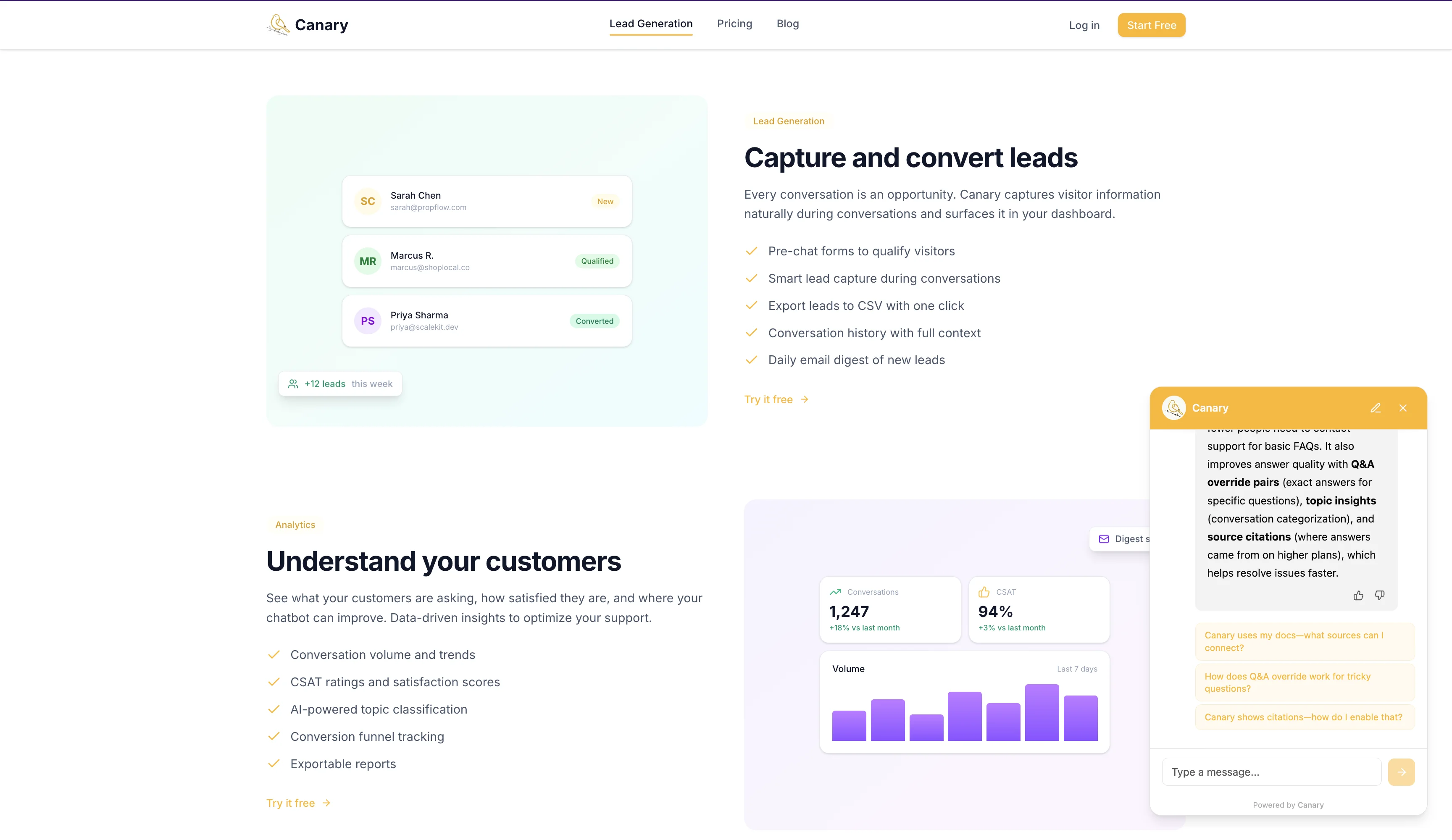
Canary offers a pre-chat form with configurable fields (name, email, phone, company, custom), auto-lead-capture that extracts contact info from natural conversation, a unified leads dashboard with search and date filters, and one-click CSV export.
Drift offered more sophisticated B2B qualification: Playbook-driven conditional flows, Fastlane for known accounts, Drift Intel for pre-identification, native Salesforce and HubSpot sync, and in-chat meeting booking. These capabilities matter when you have high inbound traffic, an SDR team, and deal sizes that justify the cost. For most small businesses, they're overhead.
Widget Performance
Canary's 4KB widget loads asynchronously with no measurable effect on Core Web Vitals or Google PageSpeed scores.
Drift's widget loaded approximately 20 JavaScript assets on page initialization. DebugBear and getbutterfly.com independently documented a −25-point mobile PageSpeed impact and 3–4 second load time increase. Workarounds existed (facade technique, DriftLinks, delayed load) but required custom engineering. For agencies managing Core Web Vitals scores for clients, that penalty showed up in rankings.
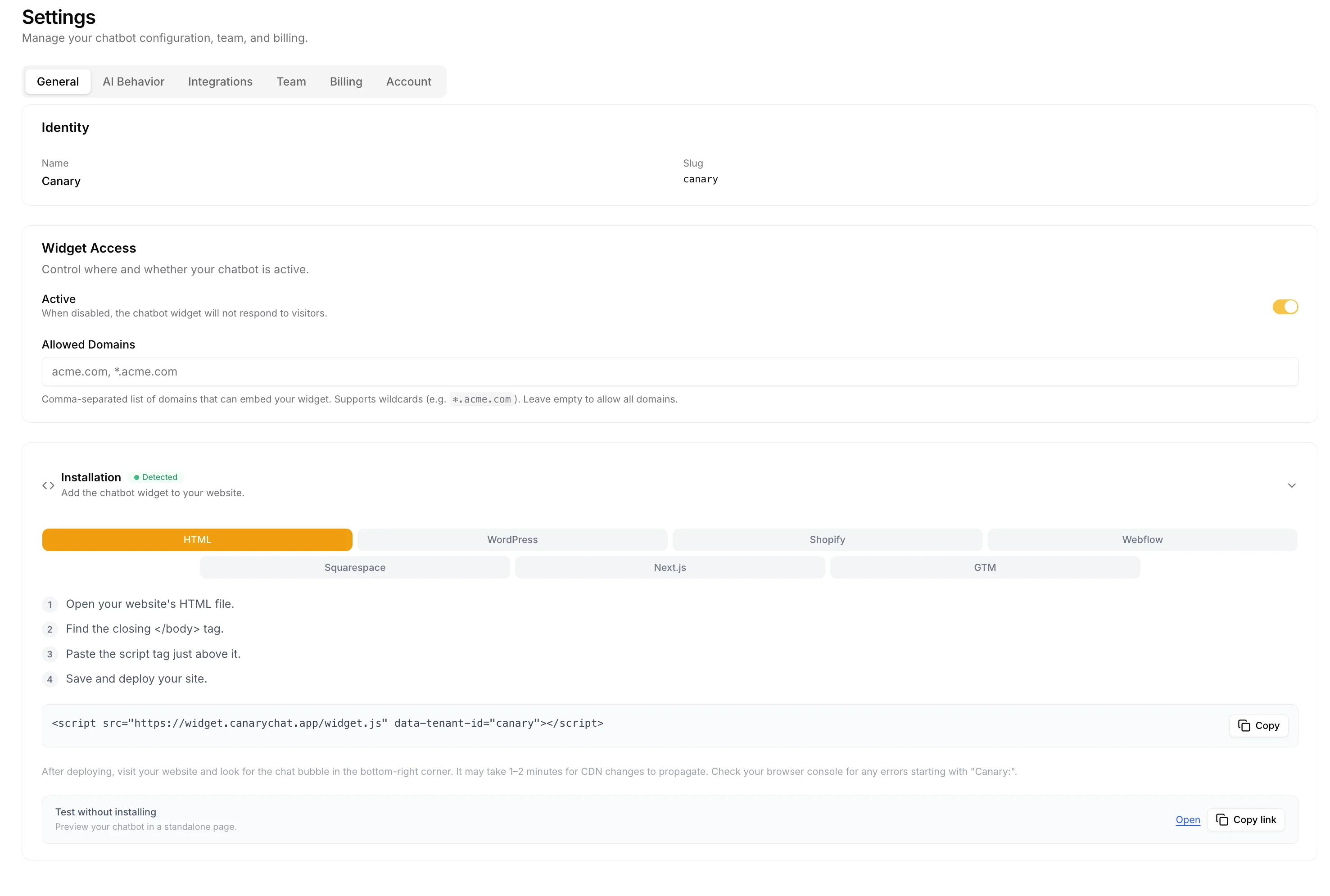
Try Canary free — live on your site in under 5 minutes →
Analytics & Reporting
Canary includes conversation volume, lead capture rate, CSAT trend, handoff rate, topic distribution (AI-powered), funnel analytics with period-over-period comparison, and source URL tracking — oriented toward understanding what visitors need and how well the AI is serving them.
Drift offered revenue attribution and sales rep performance analytics: pipeline influenced, meetings booked, ROI reporting, and Salesloft Rhythm integration. Oriented toward sales management, not visitor experience.
Pricing Breakdown
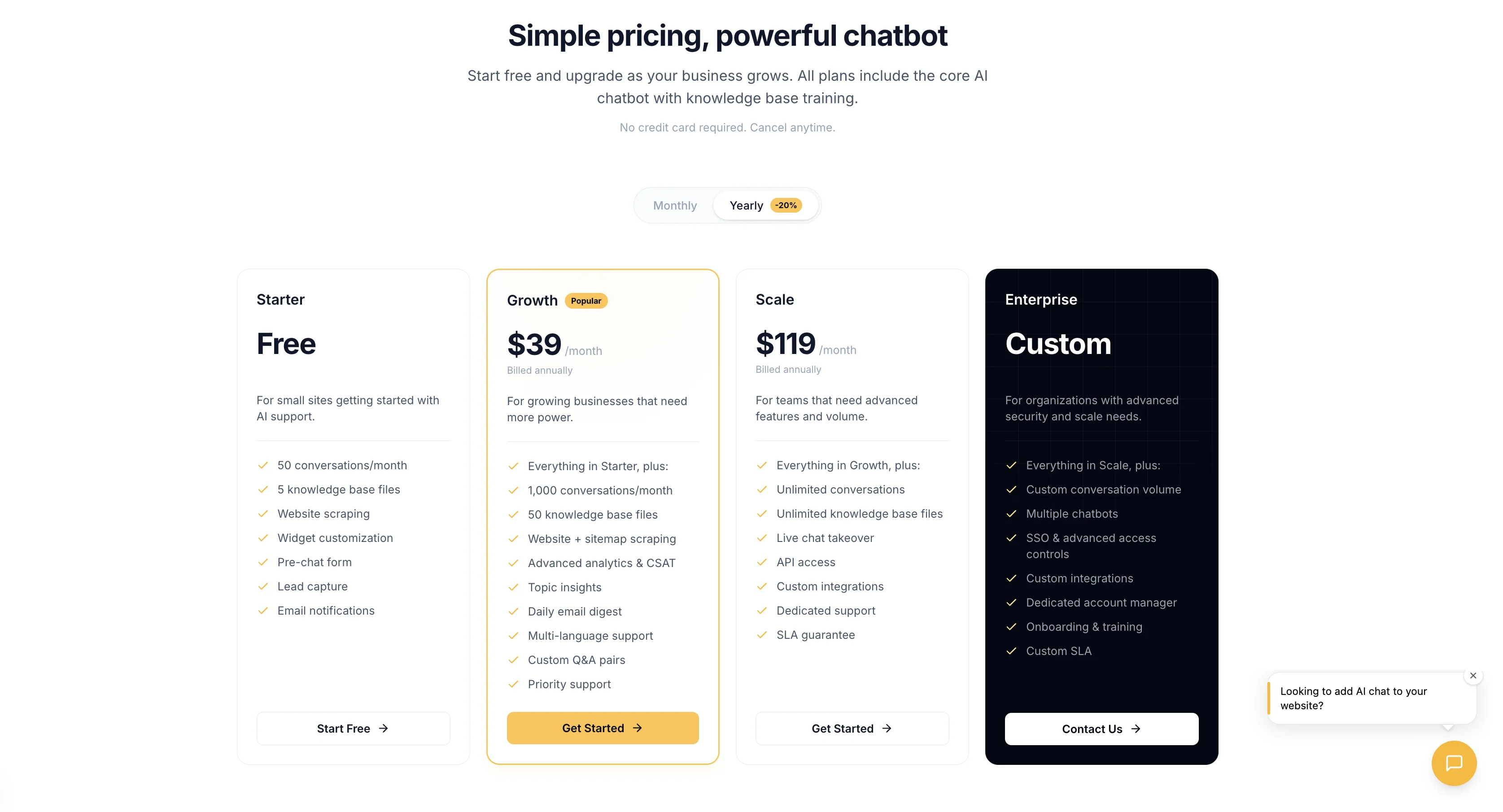
Canary Pricing
| Scale | Est. Monthly Cost |
|---|---|
| 1–3 tenants | ~$20–40/mo |
| 5–10 tenants | ~$127/mo |
| 20+ tenants | ~$200–300/mo |
All features included at every scale. No per-seat fees, no conversation overages, no annual contract, no sales call required.
Try it yourself
Your current support metrics
Canary is free on Starter, or $49/mo on Growth
Your projected savings
Monthly savings
$551
Annual savings
$6,612
ROI
1124%
Payback period
3 days
Tickets automated/mo
225
Hours saved/mo
30h
Based on industry averages. Actual results may vary depending on your chatbot configuration, knowledge base quality, and customer query complexity.
The agency math: Managing 5 client sites on Drift would have required 5 separate accounts × $30,000/year = $150,000/year. On Canary: $127/month — one dashboard, full data isolation per client.
Drift Pricing (Historical — Product Now Sunset)
Drift is no longer available to new customers. Historical pricing is included for reference only.
| Plan | Reported Cost |
|---|---|
| Premium | ~$2,500/mo ($30,000/yr) |
| Advanced | ~$3,500–$5,000/mo ($40K–$60K/yr) |
| Enterprise | ~$5,000–$10,000+/mo ($60K–$120K+/yr) |
Additional costs to budget: professional services ($5K–$15K), Salesforce integration locked to Advanced+ tier, overages as conversation volume grew, and 40%+ renewal increases reported post-Salesloft acquisition.
See Canary pricing — transparent, no sales call needed →
Integrations Comparison
| Integration | Canary | Drift |
|---|---|---|
| OpenAI | Native (Responses API + Vector Stores) | Native (GPT partnership) |
| Salesforce | Via CSV export | Native (Advanced+ only) |
| HubSpot | Via CSV export | Native |
| Marketo | Via CSV export | Native |
| Zendesk | — | Native |
| Zapier | — | Native |
| Firecrawl | Native (KB scraping) | — |
| Resend | Native (email digest + handoffs) | — |
| Supabase | Native (data layer) | — |
| CSV Export | Yes | — |
| Custom API | Yes | Yes (higher tiers) |
Drift's integration ecosystem was broader for enterprise CRM workflows. For teams that ran on Salesforce + HubSpot + Salesloft, those integrations were genuinely useful. Canary's native OpenAI and Firecrawl integrations are more relevant for knowledge-base-first deployments where the AI itself replaces much of what CRM integrations were trying to accomplish.
What Drift Users Say
Paraphrased from user feedback on G2 (4.4/5, 1,000+ reviews) and Capterra:
What they praised:
- "Fastlane has been transformative for ABM campaigns — known accounts get routed to their dedicated rep instantly, no form, no wait."
- "The Salesforce sync is deep and reliable. Every chat interaction shows up correctly on the account record."
- "AI Engagement Score genuinely helps the sales team prioritize follow-up."
- "Meeting booking flows are seamless — qualified leads book demos right in the chat."
What they reported as problems:
- "We were shocked when renewal came back 40% higher, bundled with Salesloft modules we didn't ask for."
- "Setup took 6 weeks. Playbook logic is powerful but incredibly time-consuming to build and maintain."
- "The bill tripled once our traffic hit their conversation limits. Overages were not disclosed upfront."
- "Since the acquisition, support response times got worse and the product feels deprioritized."
- "It's fundamentally a sales tool. We needed FAQ capabilities and had to build workarounds for everything."
Feature-by-Feature Comparison
| Feature | Canary | Drift |
|---|---|---|
| Product status | Active | Sunset (Mar 2026) |
| AI chatbot | Yes (RAG + OpenAI) | Yes (Playbooks + Bionic AI) |
| Knowledge base | Yes (Vector Stores, PDF/URL) | Limited (Bionic, newer feature) |
| Source citations | Yes | No |
| Sitemap import | Yes | No |
| Confidence threshold | Yes | No |
| Pre-chat form | Yes | No (Playbook-only) |
| Auto-lead-capture | Yes | Yes (Playbook-driven) |
| Visitor deanonymization | No | Yes (Drift Intel) |
| Live chat | Handoff via email | Real-time rep takeover |
| Meeting booking | No | Yes (native) |
| Rep routing | No | Yes (Fastlane + rules) |
| CSAT ratings | Yes | Yes |
| Topic classification | Yes (AI-powered) | Yes |
| Daily email digest | Yes | No |
| Suggested follow-up questions | Yes | No |
| Multi-tenant | Yes (native) | No |
| Widget performance | 4KB, no CWV impact | ~20 JS assets, −25 PageSpeed |
| Setup time | Under 5 min | Days to weeks |
| Free plan | Yes | No (historically limited) |
| Public pricing | Yes | No |
| Monthly billing | Yes | No (annual only) |
| Salesforce integration | Via export | Advanced+ only |
| Security incidents | None | 700+ orgs breached (Aug 2025) |
| Custom AI model | Yes (per tenant) | No |
Pros & Cons
Drift
Pros:
- Best-in-class B2B pipeline acceleration for enterprise sales teams
- Fastlane routing was uniquely powerful for ABM strategies
- Deep Salesforce integration (Advanced tier)
- In-chat meeting booking with no email exchange
- Drift Intel deanonymized anonymous visitors with company data
- Mature live chat with sophisticated rep routing
- Large integration ecosystem (Salesforce, HubSpot, Marketo, Zendesk, Zapier)
Cons:
- Product officially sunset — not available to new customers
- Major OAuth supply-chain breach (Aug 2025): 700+ organizations compromised
- ~$30,000/year minimum — not viable for SMBs
- No free plan, no free trial, no public pricing
- Annual contract required
- 40%+ renewal increases reported post-Salesloft acquisition
- −25 mobile PageSpeed points documented independently
- Setup took weeks; advanced features required Drift team involvement
- Salesforce locked to Advanced tier ($40K+/year)
- Not designed for customer support — no KB-first architecture
Canary
Pros:
- Under 5-minute setup via guided onboarding wizard
- 4KB widget — zero Core Web Vitals impact
- $127/month for 10 tenants — transparent, predictable, no overages
- OpenAI Vector Stores for semantic knowledge base retrieval
- Per-tenant data isolation — purpose-built for agencies and multi-site teams
- Source citations — visitors see which document the answer came from
- Confidence threshold control per tenant
- Sitemap import — bulk-train on your entire website
- CSAT ratings, topic classification, funnel analytics
- Monthly billing — no annual contract required
- Fully self-serve — configure everything from the dashboard without support calls
Cons:
- Narrower integration ecosystem (CSV export vs. native CRM sync)
- No live rep routing or Fastlane-equivalent for instant sales handoff
- No visitor deanonymization
- Newer product — smaller customer base than Drift had at its peak
- Less suited for complex multi-branch sales playbooks
What Should Current Drift Customers Do?
Clari + Salesloft is actively referring existing Drift customers to 1mind, but that's not the right fit for every use case. Here's an honest migration map:
1mind (official successor): Deploys AI "Superhumans" that can run live product demos, handle objections, and qualify inbound leads. New capabilities Drift never had — but no visitor deanonymization, no intent data, no outbound sequences. Good fit if you want AI-driven sales engagement with live-call capabilities.
Qualified: The closest direct replacement for enterprise ABM teams. Similar pipeline intelligence, visitor deanonymization, and Salesforce-first architecture. Built for the same use case at similar price points.
Intercom: If you need both sales and support chat in one platform — AI-powered knowledge base, live chat, ticketing, and CRM integrations. More expensive than Canary, less expensive than Drift was.
Canary: If you primarily used Drift for website Q&A, lead capture, and visitor engagement — rather than live sales routing — Canary covers that use case completely at a fraction of the cost.
Tidio: If budget is the hard constraint and you're a small business, Tidio offers a free tier with basic live chat and simple AI.
The right path depends on what you actually used Drift for. Sales pipeline routing → Qualified or 1mind. Knowledge-base chatbots and lead capture → Canary.
Frequently Asked Questions
Is Drift shutting down? Yes. On March 6, 2026, Clari + Salesloft announced the gradual sunset of Drift and named 1mind as the exclusive designated successor. No hard cutoff date has been set, but Drift is no longer available to new customers. This follows the August 2025 OAuth security breach and the December 2025 Clari + Salesloft merger.
What is 1mind? Is it replacing Drift? 1mind is an AI sales engagement platform founded by Amanda Kahlow (co-founder of 6sense). It deploys AI "Superhumans" — digital teammates that qualify inbound leads, join live sales calls, and run product demos. Clari + Salesloft named 1mind as Drift's official successor, and existing customers are being referred there. 1mind is a different product: it lacks Drift's visitor deanonymization, intent data, and outbound capabilities.
Was Drift hacked? Is Drift safe? In August 2025, a supply-chain attack (tracked as UNC6395) stole OAuth tokens from Drift's integration layer and used them to impersonate Drift across 700+ organizations — accessing Salesforce data and searching for AWS keys and VPN credentials. Victims included Cloudflare, Palo Alto Networks, Zscaler, and PagerDuty. The breach was confirmed by FINRA, UpGuard, Mandiant, and Cloud Security Alliance. For current Drift customers, this incident should be documented before migration.
What should current Drift customers do? Clari + Salesloft is officially referring customers to 1mind. If you primarily used Drift for website Q&A and lead capture, Canary is a functional replacement at far lower cost. If you relied on Fastlane and Drift Intel for enterprise ABM, Qualified is the closest alternative. See the migration guide above for a full breakdown.
How much did Drift cost? Drift did not publish pricing. Based on third-party reports: Premium ~$2,500/mo ($30,000/yr), Advanced ~$3,500–$5,000/mo ($40K–$60K/yr), Enterprise ~$5,000–$10,000+/mo ($60K+/yr). Annual contracts only. Professional services and conversation overages added substantially to total cost. 40%+ renewal increases were widely reported post-Salesloft acquisition.
Did Drift slow down websites? Yes. Drift's widget loaded approximately 20 JavaScript assets on page initialization — documented to reduce mobile PageSpeed scores by ~25 points and add 3–4 seconds of load time. Workarounds (facade technique, lazy-loading) existed but required custom engineering.
Does Drift work for customer support use cases? No. Drift was designed as a B2B sales pipeline tool, not a support or FAQ bot. There was no ticketing system, no KB-first design, and training on internal documents (PDFs, Notion, support tickets) was not straightforward. Teams that needed support capabilities had to build workarounds on top of Playbooks.
What is Fastlane in Drift? Fastlane was Drift's high-intent visitor routing feature. When a visitor was identified as a known target account via Drift Intel, Fastlane bypassed the qualification flow and routed them directly to an available sales rep. One of Drift's most praised capabilities — available on Advanced tier and above.
Does Drift have multi-tenant support? No. Drift was a single-workspace platform. Agencies managing chatbots for multiple clients needed a separate account and subscription for each. Canary is purpose-built for multi-tenant management with per-client data isolation from one admin dashboard.
Is Canary a good Drift alternative? For SMBs, agencies, and SaaS companies, yes. Drift was optimized for enterprise B2B sales pipeline: real-time rep routing, visitor deanonymization, deep CRM sync. Canary is optimized for AI-powered question answering from your knowledge base, lead capture, and multi-tenant management — at $127/month instead of $30,000/year. If your use case is "let the bot answer visitor questions accurately and capture contact info," Canary covers it without the enterprise overhead or the security risk.
Conclusion
Drift's story is a cautionary tale: a genuinely innovative product acquired by PE, acquired again by a platform company, hit by a major security breach, and ultimately sunset — all within five years. Fastlane, Drift Intel, and Bionic Chatbots were legitimately valuable for enterprise B2B teams with the budget and ops resources to use them. But the combination of $30,000/year pricing, the August 2025 breach, and the March 2026 shutdown means the product was never sustainable for the businesses that make up most of the market.
Canary was built for the businesses Drift couldn't afford to serve. If you need a chatbot that answers questions from your knowledge base, captures leads, hands off to a human when needed, and works across multiple client sites — without a sales call, annual contract, or Core Web Vitals penalty — that's exactly what Canary is designed to do.
Try Canary free — no credit card, no sales call required. Live on your site in under five minutes.