Tidio Alternative (2026) — Canary: Better AI, Same Price
Tidio alternative with better AI at the same price. Canary vs Tidio: pricing, AI quality, multi-tenant, lead capture compared. Try Canary free →
Tidio is one of the most-installed live chat tools on the internet, with over 300,000 businesses using it. The free plan is easy to start with, Lyro AI handles a solid portion of inbound questions, and the Shopify integration is best-in-class for e-commerce.
So why are thousands of businesses searching for Tidio alternatives every month?
Because when you look at what you actually pay — not the headline price, but the real invoice after adding Lyro AI conversations, Flows visitors, and branding removal — the cost often runs 2–3× the advertised figure. Combine that with a hard 10-seat cap on every self-serve plan, a priority-based system that means Flows take over mid-conversation and Lyro cannot seamlessly interject, and a December 2024 pricing restructure that doubled some customers' bills without warning, and you have a product that has frustrated a significant number of the businesses it was supposed to help.
Canary was built for a different use case: SaaS companies, agencies, and multi-product businesses that need to deploy isolated AI chatbots across multiple websites, products, or clients — with predictable, flat-rate pricing, a lightweight embeddable widget, and no per-conversation metering.
Jump to: Quick Verdict · About Tidio · Feature Deep-Dive · Pricing · Pros & Cons · Best For · Switching from Tidio · FAQ
Quick Verdict
| Canary | Tidio | |
|---|---|---|
| Overall | 9 / 10 | 7 / 10 |
| Features | 8 / 10 | 9 / 10 |
| Pricing Transparency | 10 / 10 | 5 / 10 |
| AI Quality | 8 / 10 | 8 / 10 |
| Multi-Tenant / Agency | 10 / 10 | 4 / 10 |
| Setup Speed | 9 / 10 | 9 / 10 |
| Ease of Use | 9 / 10 | 8 / 10 |
| Support | 8 / 10 | 6 / 10 |
(Ratings based on public G2/Capterra review data, feature analysis, and pricing transparency assessment)
Bottom line: Tidio is the better choice if you run a single Shopify store and want a battle-tested product with native e-commerce integrations and an omnichannel inbox. Canary is the better choice if you're managing multiple websites or client deployments, care about predictable costs, or need true per-tenant knowledge base isolation.
About Tidio
Tidio was founded in 2013 in Poland by CEO Tytus Gołas. It started as a live chat widget and evolved into a full customer communication platform with a unified omnichannel inbox, a visual automation builder (Flows), and an AI agent called Lyro.
As of 2026, Tidio serves over 300,000 businesses globally, with notable customers including The Body Shop, Under Armour, and Jaguar. The platform runs across five channels — website live chat, email, Instagram, Facebook Messenger, and WhatsApp — and is available on web, macOS, Windows, iOS, and Android.
Lyro AI, Tidio's flagship AI agent, is powered by Claude (Anthropic) and reports an average 64% conversation resolution rate, peaking at 67% in published benchmarks. It answers questions from a curated knowledge base, performs order lookups via Shopify, and hands off to human agents when needed. Lyro Copilot — reportedly powered by GPT-4 — drafts reply suggestions for human agents and is included on all plans.
Tidio's strength is its e-commerce depth: the Shopify integration exposes full cart contents, order history, and refund capabilities directly inside the agent sidebar, and the Flows builder includes 40+ pre-built e-commerce automation templates. A WordPress plugin with 100,000+ active installs makes Tidio one of the most widely used chat tools in the WordPress ecosystem.
The platform earns strong review scores on G2 (4.7/5, 1,800+ reviews) and Capterra (4.7/5, 800+ reviews). However, its Trustpilot rating is notably lower at 3.7–3.8/5, with 24% of reviewers giving 1 star — driven largely by billing and support complaints. Tidio received SOC 2 Type II certification in October 2025, audited by A-LIGN, covering Security, Availability, and Confidentiality.
About Canary
Canary is a multi-tenant AI chatbot platform built by Optivus for companies that need to deploy AI chat across multiple websites, products, or client accounts. Every website gets its own dedicated knowledge base, conversation history, and configuration — all managed from a single admin dashboard.
Key facts for buyers:
- Setup time: Under 5 minutes from signup to deployed widget via 5-step onboarding wizard
- Knowledge base: PDF, DOCX, CSV, XLSX uploads + URL scraping with sitemap auto-detection
- AI model: GPT-4.1 Mini by default (tenant-configurable)
- Infrastructure cost: ~$127/month for up to 10 tenants (flat rate, no per-conversation billing)
Included features across all plans: live chat handoff, CSAT ratings, lead capture forms, conversation starters, AI-generated follow-up suggestions, topic analytics, daily email digests, source citations, and proactive trigger messages.
Feature Deep-Dive
AI and Knowledge Base
Tidio (Lyro AI): Lyro is trained on a knowledge base you curate manually — FAQs, CSV Q&A files, or help center URLs. It does not learn from historical ticket data automatically; every piece of information must be intentionally added. Lyro supports 12 languages and reports an average 64% resolution rate, peaking at 67% in published benchmarks.
One important nuance: Flows and Lyro operate via a priority system within the same conversation. When a visitor triggers a Flow (a rule-based automation), Flows take precedence. Once the flow completes, Lyro handles subsequent questions. You can also configure a Flow to hand off to Lyro at a specific step using the flow builder. What this means in practice: Lyro cannot interject mid-flow, so complex journeys that mix automation and AI require deliberate configuration. It works, but it isn't seamless.
Lyro also has a monthly conversation cap. When it's hit, AI responses stop — customers either reach human agents (if available) or a static fallback message. AI coverage is directly tied to which Lyro add-on tier you're paying for, billed separately from your base plan.
Canary: Canary's knowledge base uses OpenAI Vector Stores with semantic search and a configurable confidence threshold (default 0.4, adjustable per tenant). When the AI can't find a confident answer, it routes to handoff rather than hallucinating — a design decision that prioritizes accuracy over apparent resolution rate.
Knowledge base population supports file uploads (PDF, DOCX, CSV, XLSX), direct URL scraping via Firecrawl with sitemap auto-detection, and manual Q&A pairs injected into the system prompt. Source citations appear as collapsible references so users can verify answers themselves.
AI-generated follow-up suggestions (3 contextual questions per response) keep conversations moving. Conversation starters (admin-configured, up to 4) appear before the first message to reduce friction.
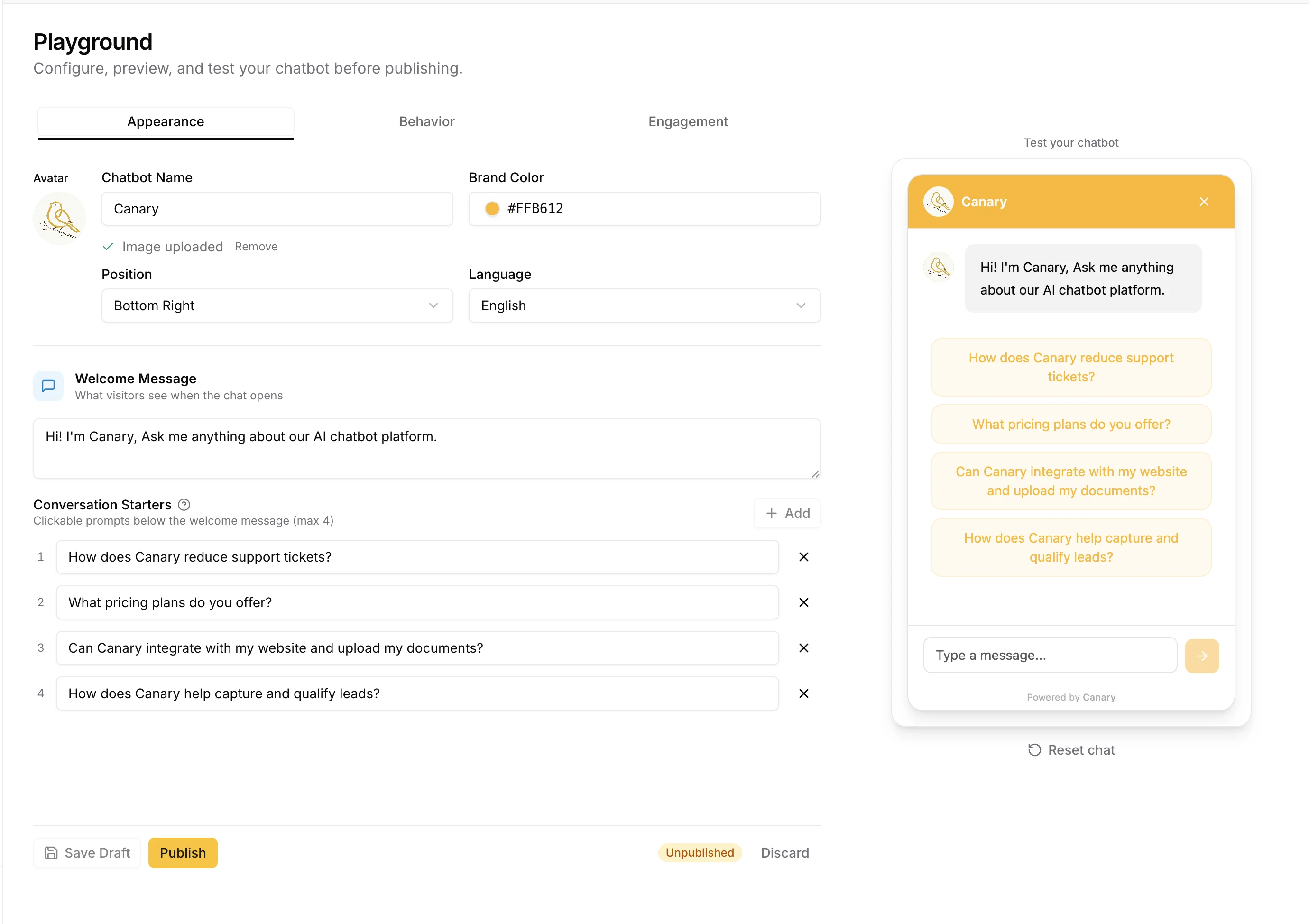
The takeaway: Canary prioritizes answer accuracy — the confidence threshold means it will route to handoff rather than guess. Tidio's Lyro prioritizes throughput with a curated knowledge approach that supports more languages but requires more manual upkeep.
Live Chat and Human Handoff
Tidio: Tidio's live chat is mature and well-designed. Agents get a unified inbox across all channels (website chat, email, Instagram, Facebook Messenger, WhatsApp), live typing preview, viewed pages history, macros for canned responses, file attachments, and CSAT measurement. Mobile apps cover iOS and Android, though the Android app has consistent complaints about missed notifications and unreliable push alerts.
Handoff triggers include: AI confidence threshold, customer request, sentiment detection, VIP customer rules, and complexity recognition. Departments (team routing) require the Plus plan at $749/month.
Hard limit: 10 operator seats on all self-serve plans. A team that needs 11+ agents must jump directly to Plus at $749/month — a $400–$690/month price cliff depending on your current plan.
Canary: Live chat handoff is included on all plans with no seat limits. When the AI hits its confidence threshold or a user requests human help, an email notification goes out via Resend with the full conversation transcript. Agents respond through the admin dashboard.
Canary does not yet have a native mobile agent app — handoff is email-based. For businesses with a dedicated 24/7 support team monitoring a native mobile inbox, this is a real limitation.
Support channel comparison: Tidio offers live chat support for Growth+ subscribers and email support on all plans. Canary provides email-based support with responses typically under 24 hours. Neither platform offers phone support.
The takeaway: Tidio for high-volume support teams with agents on mobile. Canary for smaller teams where email handoff is sufficient and seat limits are a concern.
Automation and Flows
Tidio (Flows): Flows is Tidio's visual no-code automation builder with a drag-and-drop canvas, 40+ pre-built e-commerce templates (abandoned cart recovery, shipping notifications, discount triggers), and trigger options including scroll percentage, time on page, exit intent, and URL matching.
Flows billing adds complexity: unique visitors reached by Flows are metered separately. The free plan includes 100 Flows visitors/month; paid add-ons start at ~$24–$29/month for 2,000 reached visitors. There are no flow analytics — you cannot see conversion rates, drop-off points, or branch performance data for your automations.
Canary: Canary uses proactive trigger rules (time on page, URL pattern matching, message triggers) that fire the widget's teaser bubble with a configured message. Simpler than Tidio's full Flow builder — no visual canvas or complex branching — but it integrates directly with the AI layer, meaning a proactively triggered conversation flows immediately into AI handling without mode switching.
The takeaway: Tidio for complex multi-step automation, especially e-commerce. Canary for simplicity and native AI integration without the extra billing meter.
Analytics and Reporting
Tidio: Analytics are split by tier. Basic analytics (conversation count, CSAT) are on Starter. Advanced analytics (operator performance, channel comparisons, response time, data export) require Growth and above. Flow analytics do not exist. Topic-level analytics are not available.
Canary: All analytics on all plans: conversation volume, CSAT per conversation, lead capture funnel with period-over-period comparison, topic distribution (automatic GPT classification), CSAT trends, and daily email digests. Topic insights are automatically generated — every conversation is classified on close, with no manual tagging required.
The takeaway: Canary for depth and accessibility. Tidio for per-agent performance tracking on Growth+.
Multi-Tenant and Agency Use
Tidio: Multi-project support (multiple websites under one account) is only available on Plus at $749/month. Below Plus, each website requires a separate account and subscription — separate billing, separate logins, no consolidated view. Agencies managing 5–10 client accounts face proportionally more overhead, and the 10-seat cap adds friction when agency staff and client-side stakeholders both need access.
Canary: Multi-tenant isolation is the core architecture. Every tenant (website or client) has its own vector store, conversation history, CORS-isolated widget configuration, analytics, Q&A pairs, and proactive triggers — all managed from one admin dashboard with one login. Infrastructure cost for 10 tenants: ~$127/month total, not per tenant.
→ See how Canary's multi-tenant dashboard works
The takeaway: This is the defining architectural difference. Tidio's multi-project story is an enterprise upsell at $749/month. Canary's is a day-one feature.
Data Ownership and Portability
Tidio: Conversations and contact/lead data can be exported as CSV from the inbox and contacts sections. Full API access — for programmatic data retrieval and custom integrations — is restricted to Plus and Premium plans, limiting portability on lower tiers.
Canary: Full REST API access on all plans. Conversation data, lead capture data, and knowledge base content are all exportable. Because Canary runs on your own infrastructure (Render + Vercel), your data is isolated from other tenants by architecture, not just by policy. You own the deployment.
Integrations
Tidio's integration ecosystem covers e-commerce (Shopify, WooCommerce, Magento, Shopware, Wix, Squarespace, PrestaShop, WordPress), CRM (HubSpot, Salesforce, Zoho, Pipedrive), email marketing (Klaviyo, Mailchimp, ActiveCampaign, MailerLite), customer support (Zendesk), analytics (Google Analytics, Google Tag Manager), Zapier (3,000+ apps), and omnichannel messaging (Instagram, Facebook Messenger, WhatsApp). Approximately 120 native integrations total.
Canary is API-first. The widget embeds on any website with a single <script> tag — WordPress, Webflow, React apps, or any custom stack. Native integrations are more limited: no native Shopify plugin, no CRM connectors. Webhooks and the REST API can connect to any external system, but you build the integration or use Zapier.
Integrations Comparison
| Category | Canary | Tidio |
|---|---|---|
| Shopify | Script tag (no native plugin) | Deep native (cart, orders, refunds, coupons) |
| WordPress | Script tag (any theme) | Native plugin (100,000+ installs) |
| WooCommerce | Script tag | Native plugin |
| CRM (HubSpot, Salesforce, Zoho) | Via API or Zapier | Native connectors |
| Email marketing (Klaviyo, Mailchimp) | Via API or Zapier | Native sync |
| Omnichannel (Instagram, FB, WhatsApp) | Not supported | Native inbox |
| Analytics (GA4, GTM) | Via API | Native |
| REST API | Full access (all plans) | Plus/Premium only |
| Webhooks | Yes | Limited |
| Multi-tenant management | Native (core feature) | Plus plan only ($749/month) |
The takeaway: Tidio for out-of-the-box integration breadth, especially e-commerce. Canary for API-first flexibility and multi-tenant deployment.
Pricing Breakdown
Tidio Pricing (as of March 2026)
Tidio uses three separate billing meters simultaneously — a fact easy to miss when you see the base plan price:
- Base plan (billable human-agent conversations)
- Lyro AI add-on (AI-handled conversations, billed per 50-conversation block)
- Flows add-on (unique visitors reached by automation, billed per tier)
Base Plans
| Plan | Monthly Billing | Annual Billing | Conversations | Seats | Notable Limits |
|---|---|---|---|---|---|
| Free | $0 | $0 | 50/month | Up to 10 | 100 Flows visitors; 50 Lyro conversations (one-time, non-renewing) |
| Starter | $29/month | $24.17/month | 100/month | Up to 10 | Same Lyro one-time limit |
| Growth | $59–$349/month | Lower (annual) | 250–2,000/month | Up to 10 | Branding removal +$20/month |
| Plus | $749/month | Custom | Custom | Uncapped (first) | Multi-project, departments, OpenAPI, custom AI name |
| Premium | ~$2,999+/month (reported) | Custom | Unlimited | Flexible | 50% AI resolution SLA guarantee |
Seat cap note: All self-serve plans (Free, Starter, Growth) are hard-capped at 10 operator seats total. Adding an 11th agent requires upgrading to Plus at $749/month — a significant jump from Growth's maximum of $349/month.
Add-On Costs (Required for Full AI Functionality)
| Add-On | Annual Billing | Monthly Billing | Notes |
|---|---|---|---|
| Lyro AI — 50 conversations/month | ~$32.50/month | ~$39/month | Required after the one-time free allotment |
| Lyro AI — 200 conversations/month | ~$65/month | ~$78/month | — |
| Lyro AI — high volume | Up to $700/month | — | — |
| Flows — 2,000 visitors/month | ~$24–$29/month | — | Beyond the 100 free visitors |
| Flows — high volume | Up to $299/month | — | — |
| Branding removal | $20/month | — | Growth plan only; included on Plus/Premium |
What You Actually Pay (Real-World Estimates)
| Scenario | Advertised Base | Actual Invoice |
|---|---|---|
| Small business: Growth + 200 Lyro convos + 2K Flows visitors | $59 | ~$148–$167/month |
| Mid-market: Growth (1,000 convos) + 500 Lyro + Flows + branding | $199 | ~$370–$420/month |
| Agency (11+ seats, multi-project) | $59 | $749+/month (forced to Plus) |
Note: In December 2024, Tidio restructured its pricing. Multiple verified reviews on Trustpilot and G2 report bills doubling — from $32/month to $64/month — with no advance notification before being charged. One Trustpilot reviewer wrote: "They doubled my rate without notifying me and charged me for an entire year."
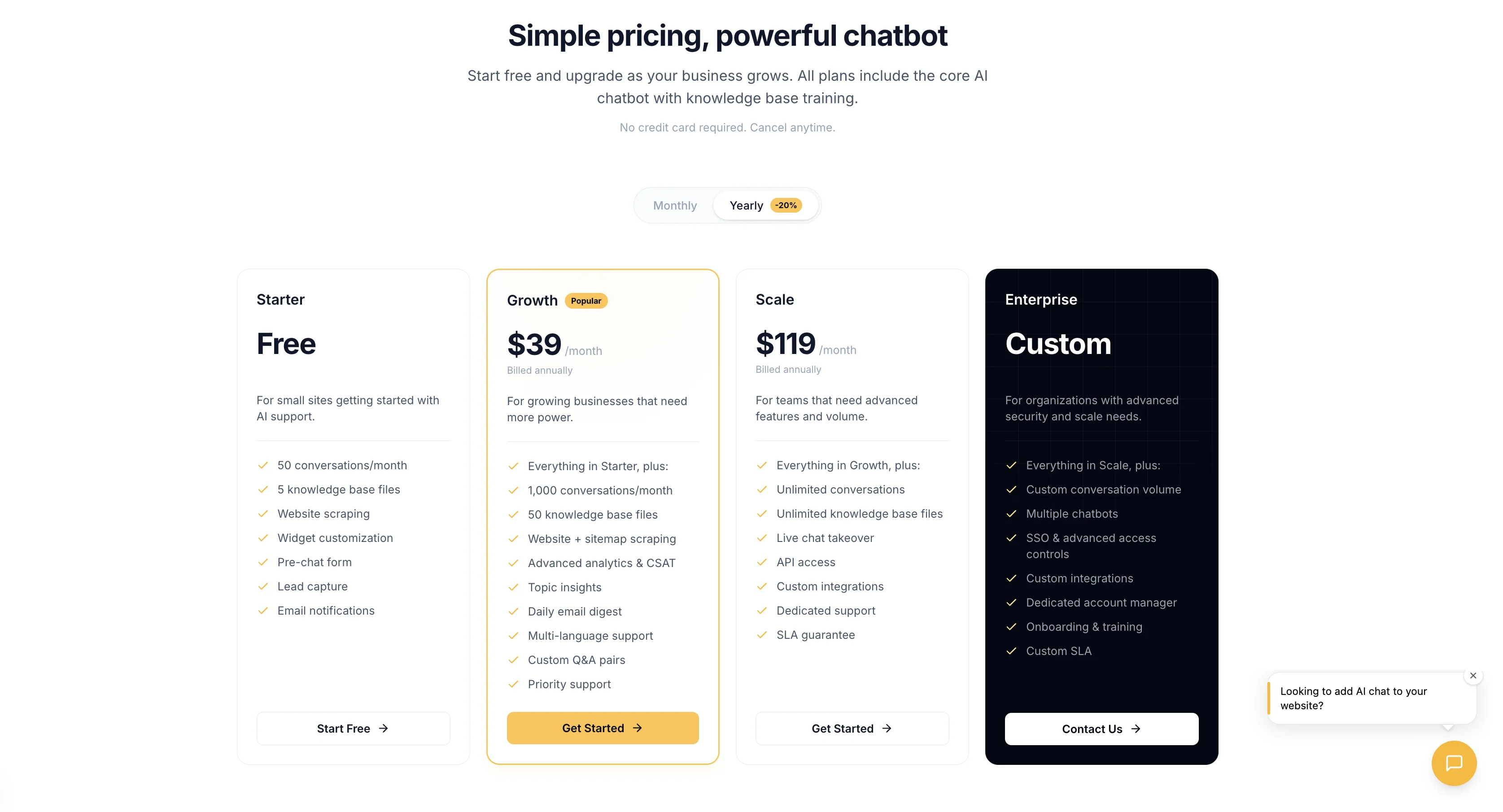
Canary Pricing
Canary uses flat-rate infrastructure pricing with no per-conversation or per-seat metering.
| Tier | Cost | Tenants | Seats | AI Conversations |
|---|---|---|---|---|
| Starter | ~$127/month | Up to 10 | Unlimited | Unlimited (OpenAI API cost pass-through) |
| Custom | Contact | 10+ tenants | Unlimited | Unlimited |
The ~$127/month covers Render (API hosting) + Vercel (admin + widget CDN). OpenAI API costs are pass-through at actual usage — for a typical small business with a few hundred conversations per month, this runs $5–$20/month in API fees.
Total cost for 5 tenants, each with moderate AI usage: ~$127 + ~$25–$50 OpenAI = $152–$177/month, all in.
Try it yourself
Your current support metrics
Canary is free on Starter, or $49/mo on Growth
Your projected savings
Monthly savings
$551
Annual savings
$6,612
ROI
1124%
Payback period
3 days
Tickets automated/mo
225
Hours saved/mo
30h
Based on industry averages. Actual results may vary depending on your chatbot configuration, knowledge base quality, and customer query complexity.
Balanced Pros and Cons
Tidio: Pros
- E-commerce depth: The Shopify and WooCommerce integrations are best-in-class. Agents see full cart contents, order history, and can process refunds without leaving the chat window.
- Unified omnichannel inbox: Website chat, email, Instagram, Facebook Messenger, and WhatsApp in one dashboard — useful for teams that want to consolidate channels.
- Lyro AI resolution rate: In published benchmarks, Lyro averages 64% conversation resolution, peaking at 67%, reducing support workload significantly.
- Fast setup: Up and running in under 30 minutes for most businesses.
- Flows builder: 40+ pre-built automation templates for e-commerce scenarios, ready to use without custom configuration.
- WordPress and broad platform support: Native plugins for WordPress, WooCommerce, Wix, Squarespace, and more.
- SOC 2 Type II certified: Completed October 2025, audited by A-LIGN. Covers Security, Availability, and Confidentiality.
- Large community: 300,000+ customers, extensive documentation, and native connections to most major e-commerce and marketing tools.
Tidio: Cons
- Triple-meter billing: Three separate usage counters (base conversations + Lyro AI conversations + Flows visitors) make budgeting unpredictable. Real costs run 2–3× advertised prices.
- Pricing transparency failures: The December 2024 restructure doubled some customers' bills without notice. Trustpilot 1-star reviews are 24% of all reviews — unusually polarized for its category.
- Hard 10-seat cap on self-serve plans: Teams needing 11+ agents must jump from Growth (up to $349/month) directly to Plus ($749/month).
- Flows priority over Lyro: Flows always take precedence in a conversation. While they can coexist, Lyro cannot interject mid-flow — complex hybrid journeys require careful configuration.
- No flow analytics: The automation builder provides zero performance data — no conversion rates, no drop-off analysis.
- Android app reliability: Consistent reports of missed chats and unreliable push notifications on Android.
- Manual knowledge curation only: Lyro cannot learn from historical ticket data. Every answer requires deliberate, manual addition.
- No HIPAA certification: Disqualifying for healthcare and other HIPAA-regulated industries.
- Billing/cancellation complaints: Multiple verified accounts report difficulty canceling, auto-renewals without notice, and unresponsive support for billing disputes.
Canary: Pros
- Predictable flat-rate pricing: One infrastructure cost, no per-conversation or per-seat meters. No billing surprises.
- True multi-tenant isolation: Per-tenant vector stores, conversation history, and configuration managed from one dashboard. Designed for agencies and multi-product companies from day one.
- Lightweight widget: Preact-based — significantly smaller than a React equivalent. Loads without impacting Core Web Vitals.
- Full knowledge base pipeline: URL scraping with sitemap auto-detection, PDF/DOCX/CSV/XLSX uploads, Q&A pairs — all feeding into OpenAI Vector Stores with semantic search.
- Source citations: Collapsible reference links let users verify answers, building trust in AI responses.
- Topic analytics: Every conversation is automatically classified by topic — no manual tagging required.
- Confidence threshold control: Adjustable per-tenant slider controls when the AI routes to handoff versus attempts an answer.
- 5-minute self-serve setup: The onboarding wizard takes new tenants from signup to deployed widget in under 5 minutes.
- All features on all plans: Analytics, lead capture, CSAT, topic insights, daily digests, source citations, conversation starters — included regardless of plan tier.
Canary: Cons
- No native mobile agent app: Handoff notifications are email-based. Agents respond through the admin dashboard, not a native mobile inbox.
- No omnichannel inbox: Website widget only — no Instagram, Facebook Messenger, or WhatsApp.
- Limited native integrations: No native Shopify plugin, no CRM connectors. Integration requires API work or Zapier.
- Smaller community: Newer platform with fewer public case studies, templates, and community resources.
- No visual automation builder: Proactive triggers exist, but there is no drag-and-drop Flow canvas for complex multi-step automation.
- Not yet SOC 2 or HIPAA certified.
Feature-by-Feature Comparison
| Feature | Canary | Tidio |
|---|---|---|
| AI chatbot | GPT-4.1 Mini (configurable) | Lyro AI (Claude/Anthropic) |
| AI knowledge base | OpenAI Vector Stores (semantic search) | Manual FAQ curation (URL + CSV + help center) |
| AI resolution rate | Not published (accuracy-first design) | 64% average, up to 67% (claimed) |
| Source citations | Yes — collapsible per response | No |
| Confidence threshold control | Yes — per-tenant slider | No public control |
| Follow-up suggestions | Yes — 3 AI-generated per response | No |
| Conversation starters | Yes — admin-configured, up to 4 | No |
| Live chat handoff | Yes — email notification + admin dashboard | Yes — native inbox |
| Typing preview | No | Yes |
| Multi-language widget | Yes (i18n support, Hindi/Devanagari confirmed) | Yes (12 languages Lyro; 6 UI packs) |
| Pre-chat lead capture | Yes — configurable form fields | Yes — pre-chat survey |
| CSAT ratings | Yes — thumbs up/down per conversation | Yes — satisfaction rating |
| Topic analytics | Yes — automatic GPT classification | No |
| Funnel analytics | Yes — with period-over-period comparison | Basic (advanced locked to Growth+) |
| Daily email digest | Yes — opt-in per tenant | No |
| URL scraping (KB) | Yes — Firecrawl + sitemap auto-detect | Yes (Lyro — help center URLs) |
| File uploads (KB) | PDF, DOCX, CSV, XLSX | FAQ files, CSV Q&A |
| Proactive messages | Yes — trigger rules | Yes — Flows (billed separately) |
| Automation builder (visual) | No | Yes — Flows canvas |
| Automation analytics | No | No |
| Omnichannel inbox | No | Yes (chat + email + Instagram + FB + WhatsApp) |
| Shopify integration | Script tag (no native plugin) | Deep native (cart, orders, refunds, coupons) |
| WordPress | Script tag (any theme) | Native plugin (100,000+ installs) |
| Multi-tenant dashboard | Yes — core feature | Plus plan only ($749/month) |
| Seat limits | None | 10 max (all self-serve plans) |
| Per-conversation billing | No | Yes — separate meter |
| Setup time | < 5 minutes | < 30 minutes |
| SOC 2 certified | No | Yes (Type II, Oct 2025) |
| HIPAA certified | No | No |
| Full REST API | Yes (all plans) | Plus/Premium only |
| Webhook support | Yes | Limited |
Best For / Not Ideal For
Choose Canary if you are:
- An agency or consultant managing AI chatbots for multiple clients. Per-tenant isolation means client A's knowledge base never bleeds into client B's answers — and you manage everything from one dashboard.
- A SaaS company with multiple products that each need separate support bots with different knowledge bases, different branding, and different conversation flows.
- Cost-conscious and scaling. At ~$127/month flat for up to 10 tenants, Canary's cost per deployment is a fraction of running 10 separate Tidio accounts.
- A developer or technical team that wants an API-first platform compatible with any stack, without being locked into a proprietary plugin ecosystem.
- Focused on knowledge accuracy. Source citations, configurable confidence thresholds, and semantic vector search prioritize giving users correct answers over maximizing apparent resolution rates.
Do not choose Canary if you:
- Run a high-volume Shopify store that needs native order management, product recommendations, and refund processing inside the chat interface.
- Need a unified inbox for website chat, email, Instagram, Facebook, and WhatsApp in one place.
- Have a large dedicated support team on mobile that needs a native mobile inbox.
- Need complex multi-step visual automation flows with branching logic and built-in templates.
- Require native CRM and email marketing integrations without custom development work.
Choose Tidio if you are:
- An e-commerce brand (especially Shopify) that wants cart visibility, order management, and abandoned cart recovery baked into the chat experience.
- A single-site business with a support team under 10 agents that values the breadth of Tidio's feature set.
- Looking for a unified omnichannel inbox to consolidate website chat, email, and social messaging.
- A business that uses Klaviyo, Mailchimp, or ActiveCampaign and wants native chat-to-email sync.
- A WordPress site owner who wants a quick drop-in plugin backed by a large community.
Do not choose Tidio if you:
- Need to manage multiple websites or clients — you'll pay $749/month before you can see all your projects in one place.
- Expect your support team to grow beyond 10 agents without a dramatic price jump.
- Want predictable monthly costs — triple-meter billing means your invoice fluctuates with every busy month.
- Work in healthcare or another HIPAA-regulated industry.
- Have been burned by surprise price increases — the December 2024 restructure is a documented data point, not speculation.
Tidio vs. Other Alternatives: Quick Context
Most businesses evaluating Tidio are also comparing it against:
- Intercom — Enterprise-grade platform with the deepest CRM and product tour features. Significantly more expensive ($74–$1,000+/month depending on contacts). Better suited for mid-market B2B SaaS; overkill for most e-commerce use cases. See our Canary vs. Intercom comparison →.
- Zendesk — Primarily a support ticketing platform that added chat. Stronger for high-volume ticket management; weaker for proactive AI chatbot use cases. Enterprise pricing positions it above both Tidio and Canary for most SMBs.
- Crisp — Developer-friendly, lower price point than Tidio, but narrower AI features and smaller integration ecosystem.
If you're evaluating Tidio specifically because you're scaling beyond a single site or need to manage multiple client accounts, Canary is the stronger architectural fit without the enterprise price tag.
Switching from Tidio to Canary
If you're an existing Tidio customer considering a switch, here's what the transition actually involves.
What transfers easily:
- Knowledge base content (FAQ text, help center articles) can be exported as CSV or copied into Canary's Q&A pairs or uploaded as documents
- The widget swap is a one-line change — replace Tidio's
<script>tag with Canary's embed code - Historical conversation data can be exported from Tidio before you cancel
What you'll rebuild:
- Tidio Flows do not have a 1:1 equivalent — you'll recreate trigger logic using Canary's proactive message rules
- If you rely on Tidio's Shopify deep integration (cart contents, refund processing), Canary doesn't replace that natively
- Omnichannel inbox (Instagram, Facebook Messenger, WhatsApp) is not available in Canary
Recommended process:
- Export your Tidio knowledge base and conversation history
- Sign up for Canary and complete the 5-step onboarding wizard (~5 minutes)
- Upload your knowledge base documents or paste FAQ content into Q&A pairs
- Install Canary alongside Tidio temporarily to verify behavior on your live site
- Cancel Tidio once you're satisfied — and do so before your annual renewal date
Frequently Asked Questions
What is the main difference between Canary and Tidio? The fundamental architectural difference is multi-tenancy. Canary was built to run isolated AI chatbots for multiple websites from a single admin dashboard. Tidio is built for single-site deployments — multi-project support costs $749/month on Plus. Pricing is also opposite in structure: Tidio bills per conversation, per AI conversation, and per Flows visitor (three separate meters). Canary uses flat-rate infrastructure pricing with no per-conversation billing.
Is Tidio free? Tidio has a free plan with 50 billable conversations/month, 100 Flows visitors/month, and up to 10 operator seats. The Lyro AI free allotment of 50 conversations is a one-time lifetime allocation — it does not renew monthly. After those 50 conversations, AI responses require a paid Lyro add-on starting at ~$32.50/month (annual billing) or ~$39/month (monthly billing).
Is Tidio legit? Is it safe to use? Yes — Tidio is a legitimate, established platform with over 300,000 business customers since 2013. It received SOC 2 Type II certification in October 2025, audited by A-LIGN, covering Security, Availability, and Confidentiality. It has been GDPR compliant since 2018. The main caveats are billing-related: the December 2024 pricing restructure triggered a wave of complaints about unexpected bill doublings, and Trustpilot reflects this with a higher-than-typical 1-star rate (24% of reviews). The platform is safe to use; the billing model requires careful monitoring.
Can I use Tidio on WordPress?
Yes — Tidio has a native WordPress plugin with over 100,000 active installs, making it one of the most widely used chat tools in the WordPress ecosystem. Installation takes under 5 minutes from the WordPress plugin directory. Canary can also be installed on WordPress using a <script> tag in your theme or via a script-injection plugin, though there is no dedicated WordPress plugin.
What are the disadvantages of Tidio? The main disadvantages: (1) unpredictable billing across three separate meters — base plan, Lyro AI add-on, and Flows add-on — that can push the real invoice 2–3× above the advertised price; (2) a hard 10-seat cap on all self-serve plans, with a steep jump to $749/month for larger teams; (3) Flows always take priority over Lyro in a conversation, requiring careful configuration for hybrid automation + AI workflows; (4) no flow analytics — you can't see conversion rates for your automations; (5) documented billing and cancellation complaints on Trustpilot; (6) no HIPAA certification.
Is Tidio good for small business? For a small business with a single website and under 10 support agents, Tidio is competitive. The free plan covers basic live chat, and the Starter plan ($24.17/month annual) is reasonably priced. Where small businesses run into trouble is growth: adding agents, automations, and AI conversations can triple the actual monthly cost before reaching 500 conversations. If you have a single site, a small team, and a tight budget, Tidio can work well. If you're managing multiple sites or expect growth, the economics shift quickly.
How do I cancel Tidio? Tidio cancellation is managed through your account settings under Billing. For annual plans, cancellation stops future renewals but does not trigger a prorated refund — this has been a recurring theme in negative reviews. Cancel before your annual renewal date and document the cancellation with a screenshot. Multiple verified reviewers recommend this step given the reported difficulty disputing charges after renewal.
Did Tidio raise prices recently? Yes. In December 2024, Tidio restructured its pricing. Multiple verified users on Trustpilot and G2 report their bills doubling — from $32/month to $64/month — with no advance notification before being charged.
Is Tidio better than Intercom? Depends on use case. Tidio wins on price, e-commerce focus, and ease of setup. Intercom wins on CRM depth, product tour capabilities, and enterprise integrations. For most e-commerce businesses under $10M ARR, Tidio offers more relevant features at a fraction of Intercom's cost. For B2B SaaS with complex customer lifecycle needs, Intercom's toolset justifies the premium. Canary positions differently from both — focused on multi-tenant AI deployment rather than unified CRM or ticketing.
Does Tidio have a CRM? Tidio has basic contact management — visitor profiles with conversation history, tags, and properties. It is not a full CRM. It integrates natively with HubSpot, Salesforce, Zoho, and Pipedrive for CRM sync, but Tidio itself is a chat and inbox platform, not a CRM replacement.
Does Tidio support WhatsApp? Yes. WhatsApp is available in Tidio's omnichannel inbox, letting agents manage WhatsApp conversations alongside website chat, email, Instagram, and Facebook Messenger from one dashboard.
Does Canary have a free plan? No. Canary uses flat-rate infrastructure pricing (~$127/month for up to 10 tenants). There is no free tier, but a trial period is available to evaluate the platform before committing. The pricing model is designed for multi-tenant deployments where per-conversation billing doesn't make sense at scale.
Conclusion
Tidio is a strong product for what it was designed to do: help a single e-commerce business — especially on Shopify — automate customer support and capture leads through a unified chat and inbox interface. The Lyro AI, Flows builder, SOC 2 certification, and 300,000+ customer base represent real substance, not marketing. If that describes your business, the native integrations and e-commerce depth are hard to beat.
The frustration with Tidio emerges at the edges. When your team grows past 10 agents. When you need to manage multiple websites. When the actual invoice comes in at 2–3× the price you planned for. When Lyro's priority system creates friction in mixed automation + AI workflows. These are real product limitations that affect real customers — as the Trustpilot data documents.
Canary is built for the scenario Tidio doesn't serve: multi-tenant AI deployment at a predictable cost, with knowledge base architecture that prioritizes accurate answers. At ~$127/month for up to 10 tenants with no per-conversation billing, no seat caps, and a lightweight widget that won't touch your Core Web Vitals, it's a fundamentally different product for a fundamentally different customer.
If you're an agency, a SaaS company, or a business with multiple web properties, the architectural fit is clear.
Ready to see Canary in action?
Last updated: March 16, 2026. Tidio pricing sourced from tidio.com/pricing. SOC 2 Type II certification confirmed at trust.tidio.com (announced October 2025, audited by A-LIGN). Review data from G2, Capterra, and Trustpilot. All prices in USD.