Chatbot vs Live Chat: Which Should You Use in 2026?
Chatbot vs live chat — real costs, customer preference data, and a decision framework to pick the right support model in 2026. See the full breakdown →
The chatbot vs live chat debate has a new answer in 2026, and it's not what most vendors want you to hear.
The old conventional wisdom said: "use chatbots for simple questions, live agents for complex ones." That's still true at a surface level. But it misses the question that actually matters for most businesses: what does the math look like? Because "use both" is only useful advice if you can afford both, and the actual cost analysis almost never shows up in these comparisons.
You'll get real cost numbers, real customer preference data, an honest look at where each option wins, and a framework to make the call for your specific business.
Before We Compare: Not All Chatbots Are the Same
Most articles comparing chatbots to live chat are quietly describing rule-based chatbots, the kind built from decision trees, keyword triggers, and "press 1 for billing" logic. In 2026, those aren't what anyone means when they say "AI chatbot."
Modern AI chatbots (including what Canary runs) are trained on your actual content: help docs, product pages, FAQs, PDFs. They use large language models to answer in natural language. The difference in capability is enormous:
| Rule-based chatbot | AI chatbot (LLM-powered) | |
|---|---|---|
| Handles phrasing variations | No — breaks on unexpected input | Yes — understands intent |
| Answers from your documentation | No | Yes — trained on your content |
| Handles follow-up questions | No | Yes — maintains context |
| Escalates intelligently | No | Yes — detects frustration signals |
| Setup time | Weeks of flow-building | Hours to days |
| CSAT at scale | Low (59% of businesses report chatbots misunderstanding nuances of dialogue — Spiceworks, 2018) | Competitive with human agents at scale (Klarna, 2024) |
When you read statistics like "69% would use a chatbot if confident it could resolve their issue faster (Solvvy, 2021)" or "65% of Power Users say they'd leave a business after a negative chatbot experience (Solvvy, 2021)," those numbers mostly reflect rule-based chatbot experiences from the pre-LLM era. AI chatbots with proper knowledge-base training perform substantially better.
The Real Costs: Chatbot vs Live Chat Staffing
This is the calculation that almost no comparison article runs, but it's the one that drives the actual business decision.
Live chat staffing costs
Let's say you want live chat coverage during US business hours: Monday–Friday, 9am–6pm. That's 45 hours/week. One full-time agent can cover ~40 hours. You need at least 2 agents to account for breaks, PTO, and occasional overlap.
| Cost item | Per agent/year |
|---|---|
| Base salary (US median for CS) | $40,000 |
| Benefits (25–30%) | $10,000 |
| Payroll taxes | $4,500 |
| Training + onboarding (annualized) | $3,500 |
| Management overhead (10%) | $5,000 |
| Tooling (helpdesk, communication) | $2,400 |
| Total loaded cost per agent | ~$65,400 |
Two agents for business-hours coverage: ~$131,000/year.
Want 24/7 coverage? You need a minimum of 4–5 agents across shifts (accounting for turnover, sick days, and handoff overlap). That's $260,000–$330,000/year, before management, QA, or training programs.
AI chatbot costs
At the mid-market level, AI chatbot platforms for a single business range from:
- $40–$150/month for self-serve SaaS tools (some offer free tiers worth evaluating)
- $500–$2,999/month for enterprise tiers with higher volume and white-labeling
For the typical SMB or SaaS company handling 2,000–5,000 conversations/month, realistic annual platform cost: $500–$2,000/year.
Industry benchmarks put the cost per AI-handled interaction at $0.50–$2.00, versus $8–$15 per human-handled resolution.
Real-world results
The clearest enterprise data point: Klarna's AI assistant handled 2.3 million conversations in its first month of global launch (February 2024). That's work equivalent to 700 full-time agents. It cut average resolution time from 11 minutes to under 2 minutes, with a projected $40M profit improvement for the year.
For a smaller-scale example: Amtrak's AI chatbot "Ask Julie" handled over 5 million inquiries per year, contributing to a 25% increase in booking completions and an estimated $1M+ in annual booking revenue, at a fraction of the cost of equivalent human staffing.
The break-even math
If your chatbot handles 50% of your incoming support volume (conservative; industry average deflection is 45%+), and you're currently paying a human agent $8–$15 per resolution, the break-even point arrives quickly:
Example: 3,000 conversations/month. 50% deflected by AI = 1,500 automated. At $10/human resolution saved = $15,000/month saved. AI platform cost: $200/month. Monthly net savings: $14,800. Annual: $177,600.
Well-implemented AI chatbots routinely deliver positive ROI within 6–12 months for businesses handling more than a few hundred monthly support conversations.
Try it yourself
Your support team details
Your true support costs
Monthly support cost
$12,190
Annual support cost
$146,280
Cost per ticket
$24.38
Effective cost per hour
$182
Total support hours/mo
67h
Hours per agent/mo
22h
With AI automation (45% of tickets)
225
tickets/mo automated
30h
hours freed up
$656
potential savings/mo
Multi-channel overhead accounts for context-switching and tool management costs. Savings assume 45% automation rate with a well-configured AI chatbot.
What Customers Actually Want (The Data Is More Nuanced Than You Think)
Customer preference data on this topic is frequently cherry-picked. The full picture:
The case for live chat:
86% of customers say they'd prefer to interact with a human agent over a bot (CGS Study). 73% rate live chat as the most satisfactory support channel (99firms), and 87% of live chat interactions receive a positive CSAT rating (LiveChat 2024).
Research is split on wait-time preferences: Market.us finds 60% of consumers would rather wait for a human agent, while Tidio's survey of 700+ consumers found the opposite (62% prefer a chatbot over waiting). The truth varies significantly by industry and customer demographics.
The case for AI chatbots:
- 64% of users cite 24/7 availability as the best chatbot feature (Outgrow)
- 68% prefer AI chatbots over waiting for a human agent when adequate (Salesforce State of Service 2024)
- 82% expect instant responses to their inquiries (Salesforce 2024)
Gen Z is the inflection point. 89% of Gen Z consumers prefer chatbots for initial contact, up from ~60% in 2022 (Salesforce 2024). And 54% of all users would choose a chatbot if it saved them 10 minutes (Solvvy, 2021).
The synthesis: customers prefer humans in principle, but prefer speed in practice. When a chatbot can resolve a question in under 2 minutes and a live agent would take 10+, most customers choose the bot. The preference for humans spikes when the issue is complex or high-stakes, when the chatbot has already failed them, or when they're frustrated.
The critical implication: a well-implemented AI chatbot doesn't compete with a live agent. It competes with a wait queue.
Do Chatbots Increase Sales? The Conversion Data
Most chatbot vs. live chat comparisons focus on support costs. The sales angle is just as important.
Live chat's conversion advantage:
Website visitors who engage in live chat are 2.8x more likely to make a purchase (Forrester / Invesp), and they spend an average of 60% more per purchase than non-chat visitors (Invesp).
For consultative and high-consideration sales, a skilled live chat agent outperforms any automated alternative. The back-and-forth of probing, objection-handling, and trust-building still belongs to humans.
AI chatbot's conversion advantage:
A Glassix study (vendor research) found AI chatbots increased conversion rates by 23% in tested deployments. Chatbot-powered pre-chat qualification and lead capture significantly outperform passive contact forms, especially after hours when agents aren't available.
Speed is the real conversion lever here. Responding to inbound interest within 5 minutes increases conversion probability by 21x. No human-staffed live chat system can guarantee that consistently at 2am.
The nuance: Live chat wins on per-conversation conversion when a skilled agent is available. AI chatbots win on total conversion because they're available 24/7 and capture inquiries that would otherwise go unanswered overnight or over weekends.
Chatbot vs Live Chat: Where Each Option Wins
AI chatbots win when:
Volume is high and questions are repetitive. Pricing, shipping status, hours, return policies, account resets. If >40% of your tickets are variations of the same 20 questions, an AI chatbot handles them better and cheaper than a human every time.
24/7 coverage is required. Staffing overnight shifts costs 4–5x your daytime rate per resolution. An AI chatbot handling overnight questions at $1/resolution vs. $20–$25/resolution for a night-shift agent is an obvious win.
Response time is the primary concern. Chatbot response: under 1 second. Average live chat first response: 1 minute 35 seconds (LiveChat 2024). When 59% of customers expect chatbot replies within 5 seconds, speed alone drives satisfaction.
Your support volume is growing, too. Chatbots scale without linear cost increases. Doubling your conversation volume doesn't double your platform cost.
AI chatbots also excel at lead capture and initial qualification, outperforming passive wait queues for conversion. And if you need multilingual support, AI chatbots can serve multiple languages from a single deployment (Hindi, Spanish, French, and others), which would require separate human agents to staff in a live chat model.
Live chat wins when:
High-stakes, emotional, or complex conversations are involved. Contract disputes, medical inquiries, enterprise sales, complaints escalated from failed automation. These require judgment, empathy, and flexibility that no chatbot reliably provides yet.
Relationship-driven sales demand it. Consultative B2B sales where the agent needs to probe, negotiate, and build trust. Live chat's average CSAT of 87% reflects skilled agents working nuanced conversations well.
Your customer base skews 45+. While Gen Z overwhelmingly prefers chatbots (89%), older demographics still prefer human interaction for anything beyond a simple lookup. Know your audience.
Regulated industries with specific compliance requirements (HIPAA conversations, financial advisory, legal consultations) also favor live chat. Human accountability is harder to replace. And if your product is genuinely complex, where explaining it takes a skilled human 10 minutes of back-and-forth, a chatbot will frustrate customers and escalate anyway.
Security, Privacy, and Implementation: What Most Comparisons Skip
Data privacy and compliance
Both options can meet GDPR and standard data compliance requirements, but the details differ:
- Live chat: Data is logged by your helpdesk platform. Retention policies are configurable. HIPAA compliance requires a Business Associate Agreement (BAA) with your vendor. For financial services and legal, verify your provider's compliance certifications.
- AI chatbots: Logs every conversation by default, which creates a richer data trail. This is useful for analytics but requires intentional data governance. Enterprise-tier AI chatbot platforms typically offer SOC 2 Type II certification and configurable data retention. For HIPAA-regulated use cases, chatbots should handle scheduling/intake only, not clinical or transactional conversations.
For regulated industries, the rule of thumb: live chat for sensitive conversations, chatbots for triage, intake, and FAQ.
Implementation timeline
| Live chat | AI chatbot (LLM-powered) | |
|---|---|---|
| Initial setup | 1–3 days (widget install, agent accounts, routing rules) | 1–5 days (knowledge base upload, escalation config, testing) |
| Go-live readiness | Fast — requires trained agents | Fast — requires quality training data |
| Ongoing maintenance | Hiring, onboarding, scheduling, QA | Updating KB when products change; monitoring escalation rate |
| Cost scaling | Linear with headcount | Near-zero marginal cost per additional conversation |
AI chatbots have higher upfront content requirements (your knowledge base must be thorough), but much lower ongoing operational cost. Live chat has lower setup cost but scales linearly with headcount.
Industry Decision Guide
| Industry | Recommended primary | Reasoning |
|---|---|---|
| E-commerce | AI chatbot (+ human fallback) | Order status, returns, shipping = repetitive high-volume queries; chatbot adoption is high industry-wide |
| SaaS / B2B software | Hybrid | Bot handles tier-1 (how-to, billing, password); human handles churn risk, enterprise deals |
| Financial services | Hybrid (human for transactions) | Regulatory complexity requires human for account actions and advisory; chatbot handles FAQ |
| Healthcare | Human-led (with chatbot triage) | HIPAA + emotional stakes; chatbot for scheduling/intake only |
| Hospitality / travel | AI chatbot | Booking status, itinerary questions, FAQs — extremely high FAQ-to-complex ratio |
| Professional services | Live chat first | Complex, relationship-driven; chatbot for intake/qualification only |
| Agencies / consultancies | Hybrid | Chatbot qualifies leads, human closes |
The Hybrid Model: How to Actually Implement It
The tier framework that works in practice:
Tier 1 — Chatbot handles autonomously (target: 60–80% of volume)
- All FAQ-type questions (your chatbot should know your entire knowledge base)
- Account status lookups via integrations
- Pricing and feature questions
- Booking / scheduling (with Cal.com or similar)
- Lead capture and qualification
Tier 2 — Chatbot attempts, then escalates (target: 15–25% of volume)
- Questions outside the knowledge base. The bot acknowledges limits and offers handoff.
- Repeated failed intents trigger automatic escalation.
- Explicit human request from the customer gets an immediate transfer.
Tier 3 — Live agent handles directly (target: 5–15% of volume)
High-value or high-risk conversations. Complaints that have already escalated. Complex multi-step troubleshooting.
The metric to watch: escalation rate. Industry leaders target <15%. If yours is above 30%, the chatbot's knowledge base needs work, not the escalation model.
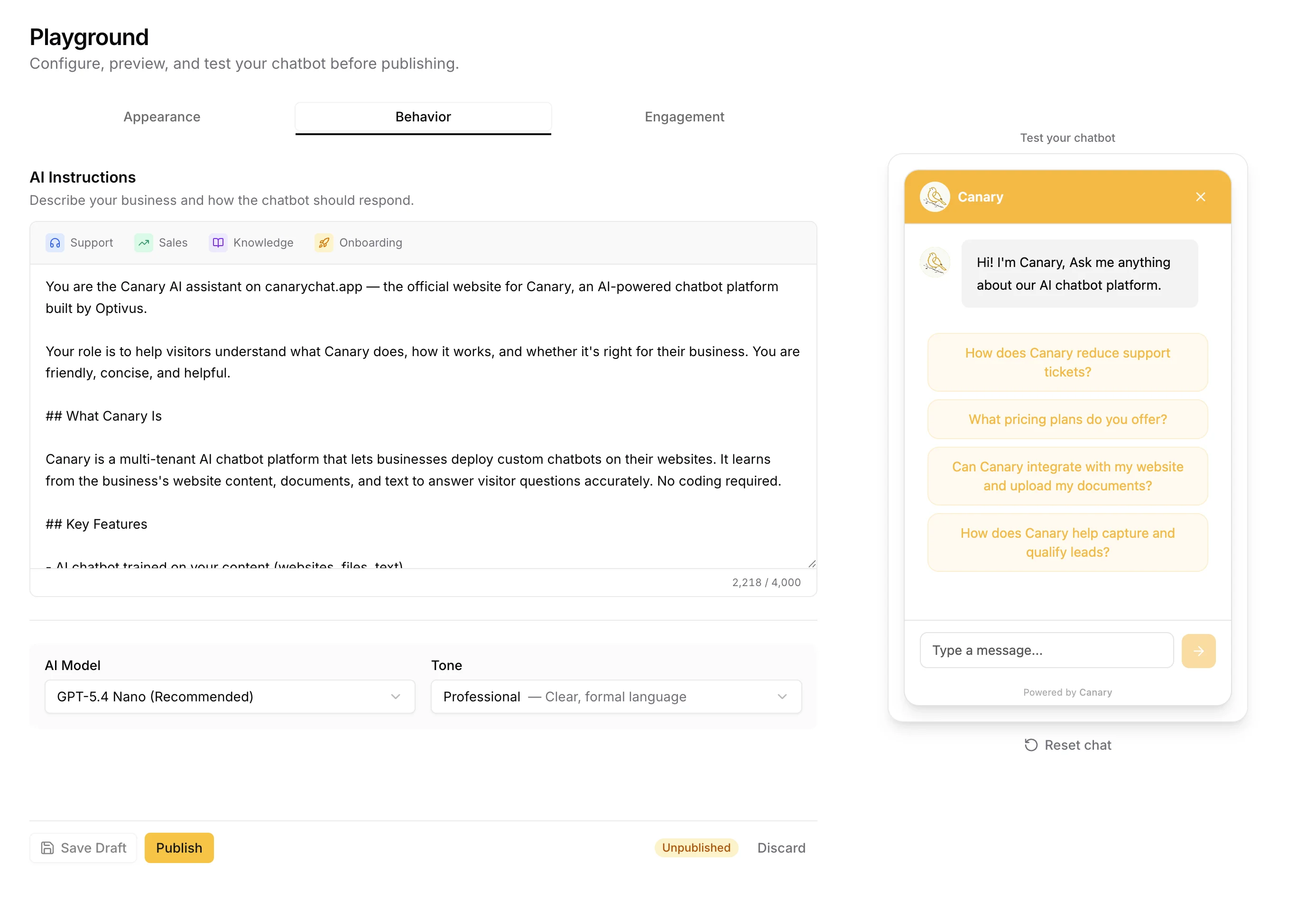
Implementation tip: don't hide the chatbot's limitations. Make the handoff clean and fast. The biggest CSAT killer isn't chatbots; it's chatbots that pretend to understand and then loop. A bot that says "I don't have enough information to answer this well, let me connect you with someone who can" scores better than one that guesses.
What to measure for each model
| Metric | Live chat | AI chatbot | Hybrid |
|---|---|---|---|
| CSAT | Per-interaction ratings | Per-interaction ratings | Track by channel separately |
| First contact resolution (FCR) | % resolved in first session | Containment rate | Bot FCR + escalation resolution rate |
| Resolution time | Minutes per ticket | Seconds per automated query | Weighted average |
| Cost per resolution | $8–$15 (US) | $0.50–$2.00 | Blended CPR |
| Coverage hours | Staffed hours only | 24/7 | 24/7 with human backup |
Canary handles the full tier 1–3 escalation model out of the box: AI responses, human handoff with full chat context, and analytics across both. See how it works →
Competitor Pricing: What You'll Actually Pay
Here's what the major platforms charge as of early 2026:
| Platform | Entry tier | Mid tier | Notes |
|---|---|---|---|
| Tidio | $24.17/mo (annual) | $49.17/mo (annual) | 50 Lyro AI conversations included on Starter; additional volume requires plan upgrade. Real cost often exceeds advertised base price at scale. |
| Chatbase | $40/mo (Hobby) | $150/mo (Standard) | +$39/mo to remove branding; metered message credits add up fast |
| Intercom | $29/seat/mo (annual) / $39/seat/mo (monthly) + $0.99/AI outcome | $85/seat/mo (annual) | Per-outcome Fin AI pricing is unpredictable at scale; 3-seat team = $87+/mo base before AI usage |
| SiteGPT | $39/mo (Starter) | $79/mo (Growth) | 4,000 messages/month limit on Starter; branding removal is +$39/mo |
| Canary | Starting from $127/mo for up to 10 tenants | — | Multi-tenant — powers chatbots across multiple sites from one platform; no per-outcome pricing. Start free → |
The hidden cost to watch: most platforms charge extra for (a) removing their branding, (b) exceeding message limits, and (c) AI features beyond the base plan. Always check the add-on pricing before committing.
FAQ
What is the difference between a chatbot and live chat? Live chat connects a website visitor with a human support agent in real time. A chatbot uses software (either rule-based flows or AI) to respond automatically without a human. Modern AI chatbots trained on your content can handle most of the same questions a live agent would, but instantly, at any hour, without staffing costs. The key functional difference: chatbots have no human judgment, empathy, or ability to go off-script when the situation demands it.
Which is better: chatbot or live chat? It depends on your conversation type and volume. For high-frequency, repetitive questions (FAQs, order status, pricing), an AI chatbot typically delivers faster responses and better ROI. For complex, high-stakes, or relationship-driven conversations, live chat still wins. Most businesses above ~500 conversations/month benefit from a hybrid model where the chatbot handles volume and humans handle the high-value interactions where judgment matters.
How much does a chatbot cost compared to live chat staffing? A realistic live chat agent costs $60,000–$80,000/year in total loaded cost (salary + benefits + overhead). AI chatbot platforms for SMBs run $500–$2,000/year. At an industry-average deflection rate of 45%+, most businesses see positive ROI within 6–12 months. The cost gap widens dramatically for 24/7 coverage, where the human model requires 4–5 agents ($260,000–$330,000/year) versus a single AI platform subscription.
Can I use both a chatbot and live chat together? Yes, and it's the recommended model for most businesses. The AI chatbot handles tier-1 volume (target 60–80%), escalates to humans when needed, and agents focus exclusively on conversations where human judgment adds real value. The key is a smooth handoff: the agent should see the full chat history without the customer having to repeat themselves.
Do customers prefer chatbots or human agents? Both, depending on the situation. 86% say they prefer humans in principle (CGS), but 82% expect instant responses (Salesforce), and 68% prefer a chatbot over waiting for a human agent (Salesforce 2024). Gen Z skews heavily toward chatbots: 89% prefer them for initial contact. The data consistently shows customers prioritize speed and resolution quality over channel. Human preference spikes when a chatbot has already failed them or the issue is emotionally charged.
What happens when a chatbot can't answer a question? A well-implemented AI chatbot detects when it's outside its knowledge base, acknowledges the limitation clearly, and offers to escalate to a human or collect a contact form submission. The worst pattern (looping the customer through failed responses) is almost always a knowledge base gap, not an inherent chatbot limitation.
The Bottom Line
The chatbot vs live chat choice in 2026 isn't really a binary decision. It's a resource allocation question. Where does human judgment add irreplaceable value? Spend your agent capacity there. Everywhere else, well-trained AI handles it better, faster, and at a fraction of the cost.
The practical starting point for most businesses:
- Audit your last 500 support conversations. Categorize each as: could have been resolved by a well-trained chatbot / needed a human / unclear. If >50% fall in the first category, an AI chatbot pays for itself quickly.
- Start with AI, add live chat for escalations, not the other way around. It's easier to add human capacity to a chatbot than to add AI to a legacy live chat setup.
- Train your chatbot on your actual content: product pages, help docs, FAQs, past ticket resolutions. Quality of training data is the single biggest driver of chatbot CSAT.
Canary is an AI chatbot platform built for businesses that need fast, accurate customer support without the cost and complexity of enterprise tools. It trains on your content, supports live chat escalation, and runs on a 4KB widget that won't slow down your site. Start your free trial →