AI Chatbot for Ecommerce: Cut Support Tickets 40%
See how an AI chatbot for ecommerce deflects 40% of support tickets, drives cart recovery, and cuts cost per query from $15 to $0.50 — with a 4-week playbook.
Every article about AI chatbots for ecommerce lists ten tools and tells you chatbots "improve customer experience." That's not helpful when you're staring at a support queue of 400 tickets on a Monday morning.
What you need is a specific, defensible answer to one question: can a chatbot actually reduce my ticket volume by 40%, and if so, how?
The short answer is yes, but only if you deploy it against the right ticket categories and you understand what it can do on the revenue side too. This post breaks down the exact methodology: which queries to automate first, how chatbots drive cart recovery and product discovery, what the math looks like, and how to go from zero to 40% deflection in four weeks.
The WISMO Problem (And Why It Owns Your Queue)
Before you buy any chatbot, look at your last 30 days of support tickets and categorize them. What you'll find, almost universally, is that a single category dominates: "Where is my order?"
WISMO queries (order status, shipping updates, delivery ETAs) account for 40–60% of all support tickets at stores processing more than 100 orders per day. Each one takes a human agent 6–8 minutes to resolve: pull up the order, find the tracking number, check the carrier API, compose a polite reply.
At scale, that's punishing. A store handling 200 orders per day might generate 80–100 WISMO tickets. At 7 minutes each, that's nearly 12 hours of agent time daily on questions that have a deterministic, automatable answer.
This single insight explains why the "40% reduction" figure isn't aspirational. It's the floor. Automate WISMO alone and you're close to it before you've touched anything else.
The Math Behind 40% Deflection
Let's put real numbers to this. Here's what a typical support operation looks like before and after an AI chatbot for ecommerce, using conservative industry benchmarks:
| Metric | Before AI Chatbot | After AI Chatbot |
|---|---|---|
| Monthly support tickets | 2,000 | 1,200 |
| Tickets deflected by AI | 0 | 800 (40%) |
| Cost per human-handled ticket | $10–$15 | $10–$15 |
| Cost per AI-resolved interaction | — | $0.50–$0.70 |
| Monthly support cost | $20,000–$30,000 | $12,400–$18,560 |
| Monthly savings | — | $7,600–$11,440 |
Human agent cost estimate from Freshworks industry benchmarks. AI interaction cost based on current chatbot platform data.
The table above assumes the chatbot is properly trained on your content. An undertrained chatbot doesn't deflect 40%. It escalates 90% with a frustrated customer attached. That's what the 4-week plan below addresses.
Try it yourself
Your current support metrics
Canary is free on Starter, or $49/mo on Growth
Your projected savings
Monthly savings
$551
Annual savings
$6,612
ROI
1124%
Payback period
3 days
Tickets automated/mo
225
Hours saved/mo
30h
Based on industry averages. Actual results may vary depending on your chatbot configuration, knowledge base quality, and customer query complexity.
How AI Chatbot Ecommerce Deployments Drive Revenue
Most stores think of chatbots purely as a support cost reducer. That's correct, but it's only half the equation. The top-performing AI chatbot ecommerce implementations also drive measurable revenue through three sales-side use cases.
Cart Abandonment Recovery
An AI chatbot embedded on your site can proactively engage shoppers who linger on the checkout page without completing a purchase. A well-timed "Need help finishing your order? Any questions about shipping or returns?" message during the checkout session recovers buyers before they leave, without requiring email retargeting workflows that can take hours to trigger and face deliverability friction.
The key is timing. In-session engagement by the chatbot is faster and more relevant than any post-session re-marketing channel. Some stores extend this to WhatsApp and Instagram DM as well, where the same AI chatbot handles cross-channel conversations from a single configuration.
Product Discovery and Guided Selling
"Which protein powder is right for a vegan who lifts three days a week?" This is the kind of question your product descriptions can answer, but shoppers rarely hunt through every page to find it. An AI chatbot surfaces the right product from your catalog in seconds, works like a knowledgeable store associate, and eliminates the friction that causes shoppers to leave and search competitors.
For stores with large SKU counts (apparel, electronics, supplements), guided selling chatbots show the most consistent lift in average order value. Customers discover complementary or upgraded products during the conversation.
Post-Purchase Upselling
Confirmation pages and post-purchase flows are an overlooked surface. A chatbot on the order confirmation page can suggest warranty add-ons, relevant accessories, or subscription upgrades based on what the customer just bought, without requiring a human to initiate the conversation.
The support savings fund the deployment; the revenue side is upside that compounds over time.
The 5 Ticket Categories an AI Chatbot for Ecommerce Eliminates
Effective AI chatbot ecommerce implementation means targeting specific, high-volume query types, not trying to automate everything at once. Here are the five categories that, together, typically account for 65–80% of total ticket volume.
1. Order Status / WISMO (40–60% of tickets)
The chatbot connects to your order management system or Shopify/WooCommerce API, looks up the order by email or order number, and returns real-time status. Resolution time: under 10 seconds. Human time required: zero.
Automation potential: 85–95% of WISMO queries can be fully resolved without a human.
2. Returns and Refund Policy Questions (10–15% of tickets)
"What's your return policy?" and "How do I start a return?" are templated answers your team types from memory 30 times a day. A chatbot trained on your policy page handles these instantly. For initiating returns, the chatbot collects the order number, reason, and condition before routing to a human, cutting agent work time by 60–70%.
3. Product Questions (8–12% of tickets)
Fit, sizing, compatibility, ingredients, materials. These questions live in your product descriptions, and the chatbot retrieves and surfaces them. For complex questions, the chatbot collects context before escalating, so the agent already has what they need.
4. Promotions and Discount Codes (5–8% of tickets)
"Do you have a student discount?" "Is there a promo for first-time buyers?" "Why isn't my code working?" Most of these are answerable from a static FAQ. The chatbot fields them 24/7, even at 2 AM when your sale goes live in a different timezone.
5. Post-Purchase Issues: Damaged or Missing Items (5–8% of tickets)
These require empathy and judgment, but the chatbot can still handle the intake: collect the order number, photo (via upload prompt), and description of the problem. When the ticket reaches a human, the intake is already complete. Estimated time savings: 3–5 minutes per ticket.
How to Hit 40% Deflection: A 4-Week Implementation Plan
Most stores underperform with chatbots because they deploy too broadly and train too shallowly. Here's the sequenced approach that consistently hits 40%+ deflection.
Week 1: The Foundation
Start with the order data connection. WISMO automation is worthless without an order lookup integration. Shopify and WooCommerce both have native APIs; configure this before anything else.
Next, upload your core documents: return policy, shipping policy, FAQ page, product care guides. These become the chatbot's knowledge base via vector search. It retrieves exact quotes, not hallucinated answers. See our chatbot knowledge base setup guide for the full walkthrough.
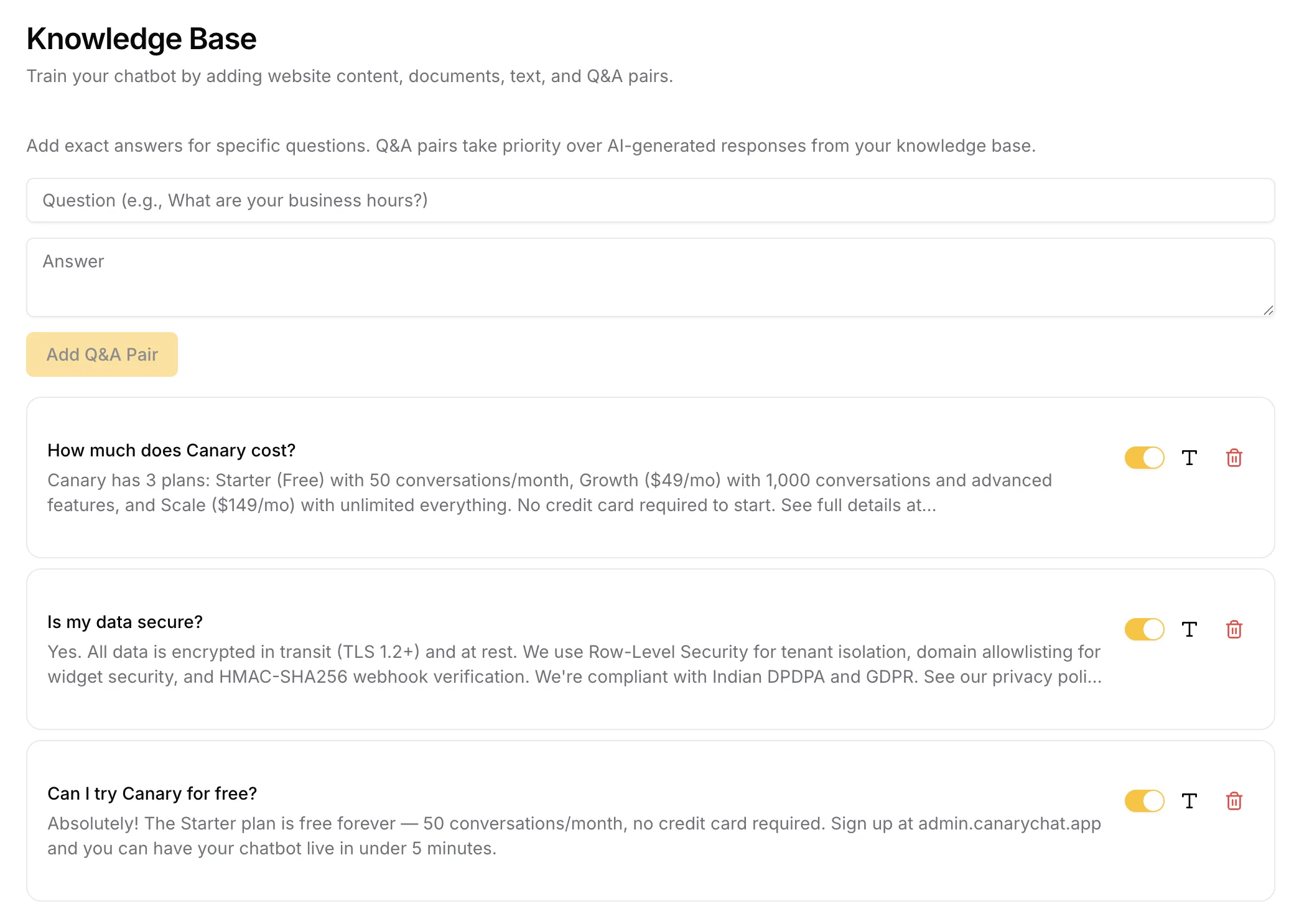
Finally, configure escalation. Decide what the chatbot can't handle (payment disputes, account security, angry or distressed customers) and set clear handoff triggers before going live.
Week 2: The High-Volume Categories
- Deploy and test WISMO automation. Run 50 internal test queries using real support tickets, not invented scenarios.
- Add returns/refund flows with conditional routing: policy question → instant answer; return initiation → intake form → human handoff.
- Set up off-hours coverage. This alone captures 20–30% of volume that would otherwise wait until morning.
Week 3: Product and Promotional Content
- Upload your full product catalog or product FAQ document.
- Add current promotion details and automate the update process so the chatbot never serves stale discount codes.
- Review chatbot transcripts from weeks 1–2. Every "I don't understand" response is training data.
Week 4: Tune and Measure
Check your deflection rate. Industry benchmarks: 25% is baseline, 40% is achievable with proper training, 60%+ is possible for stores with comprehensive documentation.
Review escalated conversations. Identify the top 10 categories the chatbot couldn't handle and add content for each. Then set a monthly review cadence. Performance decays when your product catalog or policies change and the knowledge base isn't updated.
Quick win: If you're on Shopify, WISMO automation alone typically gets you to 25–30% deflection within the first 10 days. See the WISMO automation guide for Shopify for the exact API configuration steps.
Common Implementation Mistakes to Avoid
The biggest one: going live without real-query testing. Your team's invented test questions aren't representative. Gather 50 real support tickets and use them as the test set before launch.
Tone matters too. A bot that sounds like a legal document kills engagement. Match the voice to your brand, keep it conversational and brief.
- No feedback loop. Reviewing 10 escalated conversations per week in month one is the fastest optimization lever available. Skip it and you're flying blind.
- Treating setup as one-and-done. Every new promotion, new SKU, and policy change needs a knowledge base update. Build this into your operations calendar.
A Note on Privacy and Compliance
Ecommerce chatbots handle personally identifiable information: order numbers, email addresses, shipping details. Before deploying, confirm your platform stores data in compliant infrastructure (EU data residency for GDPR-regulated customers), add a brief disclosure that chats may be logged for quality review, and ensure payment card data never flows through the chatbot.
AI Chatbot Ecommerce Pricing: What You're Actually Paying
One thing the listicle articles won't tell you is what ecommerce chatbots actually cost once you include the line items buried in footnotes. We break down the full analysis in our chatbot pricing comparison guide. Here's the summary:
| Tool | Advertised Starting Price | Real Monthly Cost (Mid-Size Store) | Key Hidden Cost |
|---|---|---|---|
| Tidio | $29/mo | $100–$200/mo | Lyro AI add-on +$39/mo; Flows add-on +$29/mo |
| Intercom Fin | $29/seat/mo | $600–$2,000+/mo | $0.99 per AI outcome (resolution or procedure handoff) |
| Gorgias | $10/mo (Starter) | $300–$750/mo | $0.90–$1.00 per AI interaction + counts as a ticket |
| Chatbase | $40/mo | $80–$200/mo | Custom domain +$59/mo; extra credits +$12/1,000 |
| SiteGPT | $39/mo | $49–$99/mo | No free plan; limited integrations |
| Canary | $127/mo for up to 10 sites | $127/mo flat | None — flat per-tenant pricing |
The Intercom line deserves extra attention. At 1,000 AI outcomes per month (modest for a busy store) you're paying $990 in AI fees alone before any seat costs. Gorgias uses a similar model: every AI interaction costs extra and counts as a ticket in your quota, creating a compounding cost spiral as you scale. With per-interaction pricing, your unit economics deteriorate precisely as your chatbot gets better at its job.
Want to see how your current support costs stack up? Start a free Canary trial and run the deflection math against your actual ticket volume. Setup takes an afternoon.
What to Measure: Key KPIs for an AI Chatbot Ecommerce Deployment
Beyond deflection rate, these are the five metrics that matter:
| KPI | What It Tells You | Healthy Benchmark |
|---|---|---|
| Deflection rate | % of conversations fully resolved by AI | 25% baseline; 40%+ with proper training |
| Escalation rate | % handed off to humans | <20% for well-trained chatbots |
| First Contact Resolution (FCR) | % resolved in one chat session | >75% for WISMO and policy questions |
| CSAT score | Customer satisfaction with chatbot responses | >4.0/5.0 or >80% positive |
| Avg response time | Time to first chatbot response | <3 seconds |
Track these weekly for the first 30 days. After that, monthly reviews are sufficient unless deflection rate drops, which is a reliable signal that your knowledge base is outdated.
Real-World Results: What the Data Shows
Klarna (Fintech/Ecommerce — 150M+ users) In its first month with an AI chatbot, Klarna handled 2.3 million customer service conversations, equivalent to the work of 700 full-time agents. Average resolution time dropped from 11 minutes to under 2 minutes. Customer satisfaction scores matched human agent performance with a 25% drop in repeat inquiries. (Source: Klarna press release, February 2024)
Small and mid-size Shopify stores (industry benchmarks) Across implementations at smaller stores, AI chatbots with WISMO integration show 35–60% ticket volume reductions. Store owners consistently report reclaiming the equivalent of a part-time hire in weekly support hours, significant whether you're processing 100 or 1,000 orders per month. (Source: AddWebSolution, 2025)
McKinsey AI in contact centers (2025) In McKinsey's analysis of AI agents deployed in customer service contexts, AI-assisted operations reduced cost-per-call by 50% while maintaining or improving customer satisfaction. That's the clearest independent validation that chatbot economics are real, not vendor-inflated. (Source: McKinsey & Company, 2025)
The consistent pattern: stores and companies hitting the highest deflection rates connect their chatbot to live operational data, keep documentation updated as products and policies change, and review transcripts regularly in the first 90 days.
AI Chatbot vs. Live Chat: Which Does Your Store Need?
| AI Chatbot | Live Chat | |
|---|---|---|
| Availability | 24/7, instant | Business hours; queue delays |
| Volume handling | Unlimited concurrent | Limited by agent headcount |
| Best for | WISMO, policy, product FAQ, intake | Disputes, complex issues, high-stakes decisions |
| Cost at scale | Fixed or low per-interaction | Linear with conversation volume |
| Setup time | 1–3 days (knowledge base upload) | Hiring + training time |
The right answer for most growing stores: AI chatbot handling everything it can, with a clear handoff to a human for anything it can't. The chatbot resolves 40–60%, humans handle the rest. That's the standard at stores with the best support unit economics.
Most modern chatbot platforms support this model natively. The chatbot collects context during intake, then hands the conversation to a live agent with the full transcript attached. The agent never starts cold.
Frequently Asked Questions
What is an AI chatbot for ecommerce? It's a customer-facing assistant that handles support queries, product questions, and post-purchase issues automatically, typically embedded on your storefront as a widget. Modern ecommerce chatbots use large language models (like GPT-4.1) to understand natural language questions and retrieve answers from your knowledge base, rather than following rigid decision trees.
How much does an AI chatbot cost for ecommerce? Starting prices range from $29/mo (Tidio, Intercom Fin seat cost) to $39–$40/mo (SiteGPT, Chatbase) to $127/mo flat (Canary, up to 10 sites). Some platforms also offer free tiers worth testing before you commit. The critical factor is per-interaction vs. flat-rate pricing. At 1,000 AI outcomes per month, Intercom's $0.99 model costs $990 in AI fees alone, before seat costs. Flat-rate pricing means your cost doesn't scale with success.
What are the disadvantages of AI chatbots in ecommerce? The real risks: (1) Hallucination — chatbots not grounded in your actual documentation may invent return policies or shipping timeframes. Use platforms with knowledge-base retrieval, not raw LLM access. (2) Tone mismatch, where a bot that sounds robotic or overly formal can hurt brand perception in premium segments. (3) Setup investment, since the first month requires real effort to train the chatbot on your content. (4) Maintenance, because every policy change or new product launch needs a knowledge base update. None of these are dealbreakers. They're operational realities to plan for.
What's the realistic ROI timeline for an ecommerce chatbot? Most stores see measurable deflection within 14 days of deployment if WISMO is configured. Full cost recovery, where chatbot cost is offset by agent time saved, typically arrives within 3–6 months. McKinsey's 2025 research on AI in customer service shows 50% cost-per-call reductions are achievable at scale; Salesforce data indicates 30% of support cases are already being fully resolved by AI in production deployments.
Can a chatbot handle returns and refunds? Yes and no. It can answer policy questions instantly. It can collect intake information (order number, reason, item condition) before routing to a human. It can initiate a return flow if you have an automated returns tool. It should not make refund decisions autonomously, since that requires human judgment and account access.
How do I integrate a chatbot with Shopify or WooCommerce?
Most platforms embed via a JavaScript snippet in your theme (Shopify: App Embed block or theme.liquid; WooCommerce: functions.php or a plugin). For WISMO, you'll also connect via the Shopify Admin API or WooCommerce REST API to enable real-time order lookups. The WISMO automation guide for Shopify walks through the exact configuration steps.
The 40% Isn't a Ceiling
The stores that hit 40% ticket deflection and stop there are leaving results on the table. Continued transcript review, expanding the knowledge base, and adding proactive touchpoints (shipping confirmation with embedded tracking link and a chatbot CTA) push deflection rates to 60%+ within 90 days for stores that stay consistent.
If you want to see what 40% deflection looks like for your specific ticket mix, Canary offers a 14-day trial with full WISMO integration, knowledge base ingestion, and a widget that loads fast enough not to affect your Core Web Vitals. Setup takes an afternoon.
Stats sourced from: Freshworks industry benchmarks (2025), McKinsey & Company AI in Customer Service (2025), Salesforce State of Service (2025), Klarna AI assistant press release (February 2024), AddWebSolution small-store benchmarks (2025), Pega/YouGov consumer AI confidence survey (2025).